

Variable Gravity Opens a New Question in Space Combustion
Combustion in space is not simply the same fire seen on Earth. A new perspective paper in npj Space Exploration argues that variable gravity combustion should be studied as a distinct field because rockets, spacecraft, aircraft, and future deep-space missions often move through changing acceleration environments rather than one fixed gravity condition.
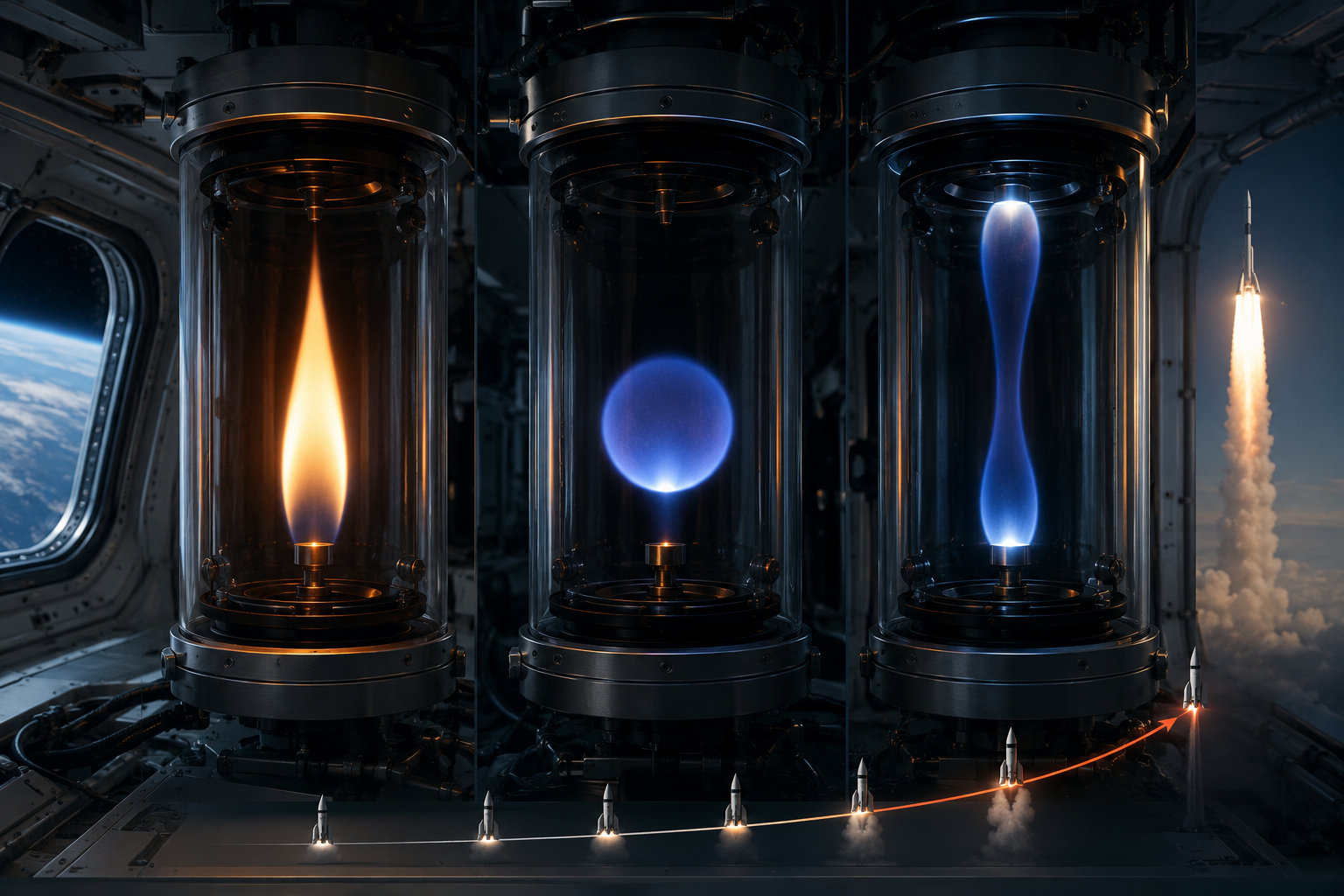
The paper explains that gravity affects flame structure, heat transfer, soot formation, ignition, stability, propagation, and extinction. Under normal gravity, buoyancy-driven convection strongly shapes flames. In microgravity, where buoyancy is largely removed, flames become more dependent on diffusion and chemical kinetics. In supergravity, stronger buoyancy and turbulence can produce hotter, faster-burning, and more unstable flames.
Why Fixed-Gravity Experiments Are Not Enough
Much of today’s combustion research has focused on steady gravity conditions such as microgravity, normal gravity, or supergravity. The authors argue that this does not fully represent real aerospace environments, where gravity can shift rapidly during launch, orbital insertion, manoeuvring, re-entry, and landing.
A key point in the paper is that variable gravity may produce “memory effects,” where a previous gravity state influences the flame’s later behaviour. This means variable gravity combustion cannot be treated as a simple addition of separate microgravity, normal gravity, and supergravity results.
Flames in Microgravity and Low Gravity
In gravity levels below normal Earth gravity, buoyancy is reduced. This helps researchers isolate fundamental combustion processes that are harder to observe on Earth. The paper notes that microgravity studies have revealed important changes in flame propagation, stability, heat transfer, and pollutant formation.
Microgravity flames can behave in unexpected ways. For example, coflow jet flame studies have shown much higher soot production under microgravity compared with normal gravity. Other experiments have examined flame extinction, quenching, blow-off, and the role of radiation and strain in partially premixed flames aboard space platforms.
Supergravity Brings Its Own Challenges
The study also reviews combustion under gravity levels above Earth normal. Supergravity can intensify natural convection and change flame shape, length, width, heat release, and stability. Research using spin testers, centrifuges, and parabolic flight has shown that diffusion flames can change dramatically as gravity increases.
However, the authors note that supergravity combustion remains less developed than microgravity research. Many experiments have been limited by narrow gravity ranges, simplified setups, near-atmospheric pressures, and incomplete model validation. More systematic experiments are needed to connect observed flame behaviour with stronger theoretical models.
Future Research: Theory, Simulation, and AI Diagnostics
The paper proposes three major directions for future work: stronger theoretical frameworks, high-fidelity numerical models, and intelligent diagnostic systems. Theoretical studies need to test whether common dimensionless numbers used in combustion science remain valid under changing gravity and pressure conditions.
Numerical models will be needed to simulate complex flow, heat transfer, and chemical reactions in variable gravity environments. The authors also highlight deep learning as a potential tool for real-time flame monitoring and prediction, especially where combustion behaviour becomes nonlinear and difficult to model with traditional methods alone.
Why It Matters for Spaceflight
Understanding variable gravity combustion could improve spacecraft fire safety, propulsion systems, aviation safety, and mission planning for the Moon, Mars, Venus, and deeper space. It may also help engineers predict flame instability, ignition limits, extinction behaviour, and soot formation in environments where gravity is constantly changing.
The study frames variable gravity combustion as an underexplored but important field. As space missions become more complex, flame science will need to move beyond fixed-gravity assumptions and account for the dynamic conditions spacecraft actually experience.