

A new way to spot hidden supermassive black hole pairs
Supermassive black hole binaries are expected to form naturally when galaxies merge, but finding close pairs has remained one of the major challenges in modern astrophysics. A new study proposes that some of these hidden systems could reveal themselves not through gas or jets, but by acting as powerful gravitational lenses that repeatedly brighten the light of stars behind them.
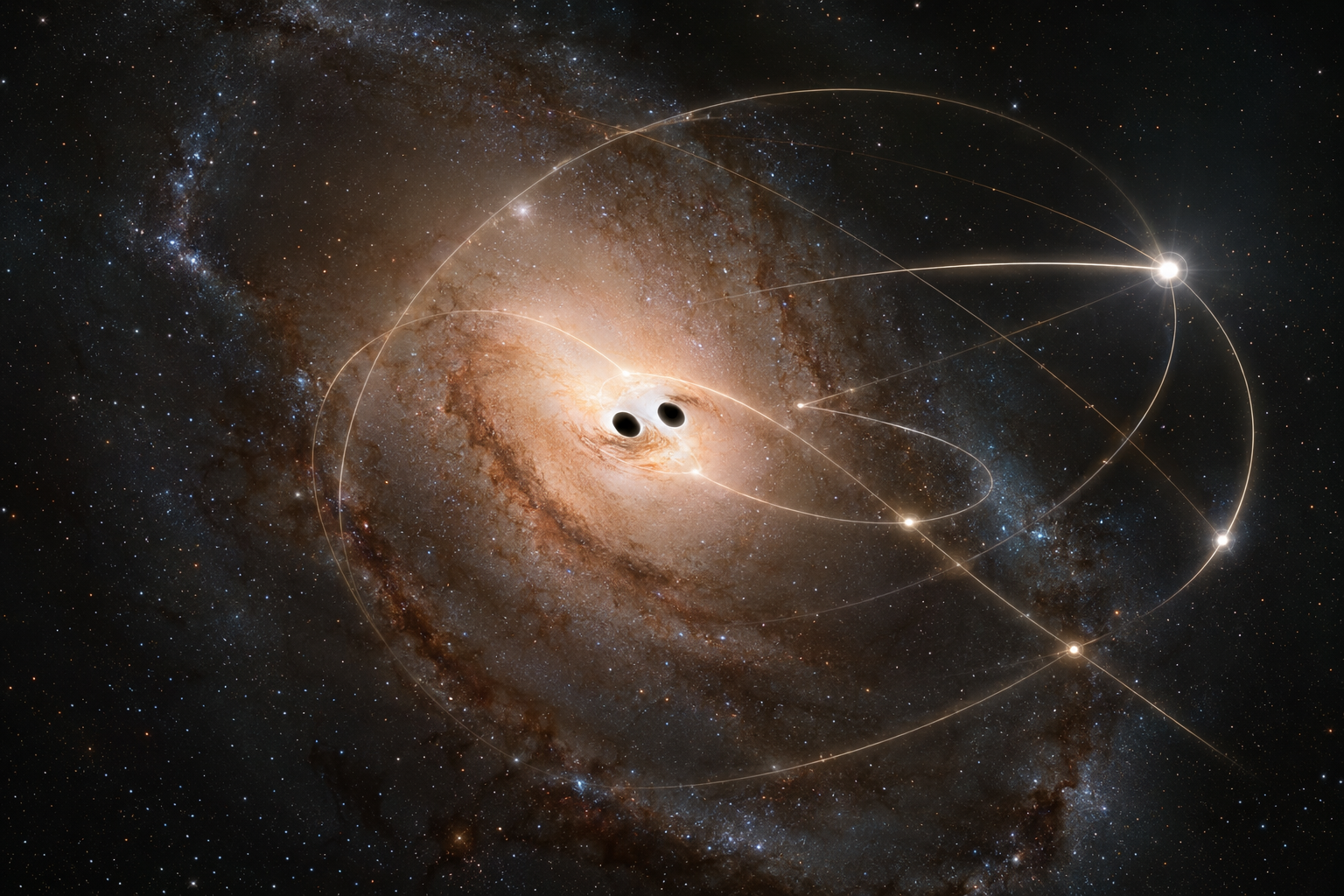
The effect is called quasiperiodic lensed starlight, or QPLS. In this scenario, a bright star located behind a supermassive black hole binary in the same galaxy is strongly magnified as the binary’s gravity bends and focuses its light toward Earth. Because the black holes orbit each other, the regions of strongest magnification rotate over time, creating recurring brightening events that can leave a distinctive pattern in the host galaxy’s light curve.
How the lensing signal works
The proposed mechanism relies on a feature of gravitational lensing known as a caustic, where light from a background source can be amplified enormously. For a binary system, these caustic structures are not fixed. They move and rotate as the black holes orbit and gradually inspiral toward each other.
If a bright star lies in the right position behind the binary, the rotating caustic can cross the star multiple times during an orbit. Each crossing can produce a sharp spike in brightness. According to the study, the timing, spacing, and shape of these spikes can carry information about the binary’s mass, orbital period, inclination, and eccentricity.
This makes the light curve useful in a way that resembles a gravitational-wave signal. Instead of directly recording ripples in spacetime, astronomers would be reading an electromagnetic pattern encoded in the changing brightness of a galaxy’s core.
Why this matters for black hole astronomy
Many existing methods for identifying close supermassive black hole binaries depend on active galactic nuclei, where gas falling onto the black holes produces bright and variable emission. But most galaxies are not actively feeding their central black holes, which limits those approaches.
The new QPLS method is important because it does not require the black hole binary to be surrounded by gas. Even a quiescent galactic nucleus could, in principle, produce a detectable signal if a sufficiently bright background star is highly magnified.
The authors argue that such lensing events could sometimes make a single star appear bright enough to rival the luminosity of an active galactic nucleus. That means otherwise quiet galaxies could briefly show dramatic central variability driven purely by lensing.
What the models suggest
The paper models several cases, including very massive binaries relevant to pulsar timing array observations and lighter systems that may later enter the detection range of future space-based gravitational-wave observatories such as LISA and TianQin.
In one example, an equal-mass binary composed of two extremely massive black holes produces repeated magnification peaks over the final years before merger. As the orbit shrinks, the shape and strength of the peaks change in a predictable way. In other examples involving eccentric binaries, the lensing signal could appear months to years before the system becomes visible to gravitational-wave detectors, potentially serving as an advance warning.
The study also explores cases where electromagnetic and gravitational-wave observations could overlap. Highly eccentric binaries may be especially promising because their orbital geometry can create strong lensing signatures while also producing detectable gravitational-wave bursts before the final merger.
A possible bridge to multimessenger astronomy
If confirmed observationally, QPLS could become a new multimessenger tool. A repeating optical or ultraviolet signal from a galaxy’s centre might flag the presence of a supermassive black hole binary well before its merger. Astronomers could then monitor that galaxy with future gravitational-wave instruments, improving the chances of a coincident detection.
That would be valuable for more than just discovering binaries. It could help researchers connect black hole mergers to specific host galaxies, improve measurements of cosmic distances, and test how gravity behaves in the strong-field regime.
Where astronomers may find these signals
The authors point to time-domain surveys as the most promising place to search for QPLS events. Facilities such as the Zwicky Transient Facility, Subaru Hyper Suprime-Cam, the Vera Rubin Observatory, the Roman Space Telescope, and ULTRASAT could all contribute, depending on survey cadence, sensitivity, and wavelength coverage.
Because the predicted signals can last from hours to years depending on the system, both wide-field surveys and targeted follow-up campaigns may be useful. Future analyses may also use matched-filter style searches, similar to those used in gravitational-wave astronomy, to recover faint QPLS patterns from noisy data.
What remains uncertain
The idea is currently theoretical and still needs observational confirmation. Real galaxies are more complex than idealised models, and many factors could affect detectability, including the motions of stars, stellar crowding, gas near the binary, and the cadence limits of current surveys.
The authors also note that additional work is needed to estimate event rates more precisely and to understand how often suitable stars align with the rotating caustic structure of a supermassive black hole binary.
A new route to the final parsec problem
Despite those uncertainties, the study offers a striking new possibility: close supermassive black hole binaries may be detectable through repeating flashes of magnified starlight, even when their host galaxies appear inactive. If such signals are found, they could provide a new way to study how black hole pairs evolve from galaxy mergers toward eventual coalescence. In doing so, QPLS may open an unexpected observational window onto some of the most extreme systems in the universe.