

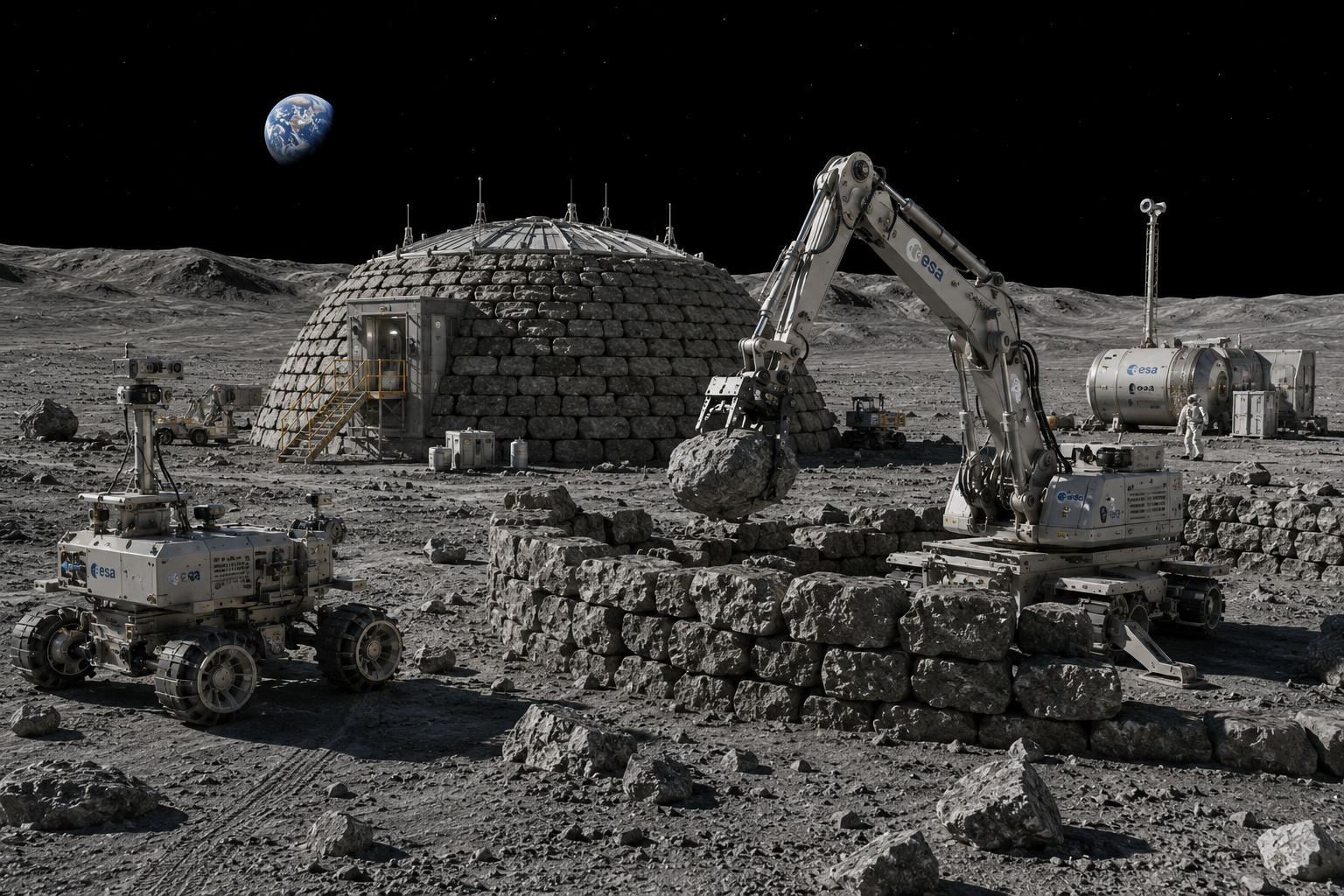
Future lunar bases may not need to rely only on bricks, concrete-like regolith blocks or materials launched from Earth. A new study published in npj Space Exploration presents a computational design method that could help robots build Moon infrastructure directly from unprocessed stones found on the lunar surface.
The research focuses on a practical challenge for long-term Moon exploration: how to construct useful infrastructure while reducing transport mass, energy demand and human intervention. Instead of melting, sintering or binding lunar regolith into manufactured blocks, the proposed method plans how irregular stones could be assembled into stable masonry structures.
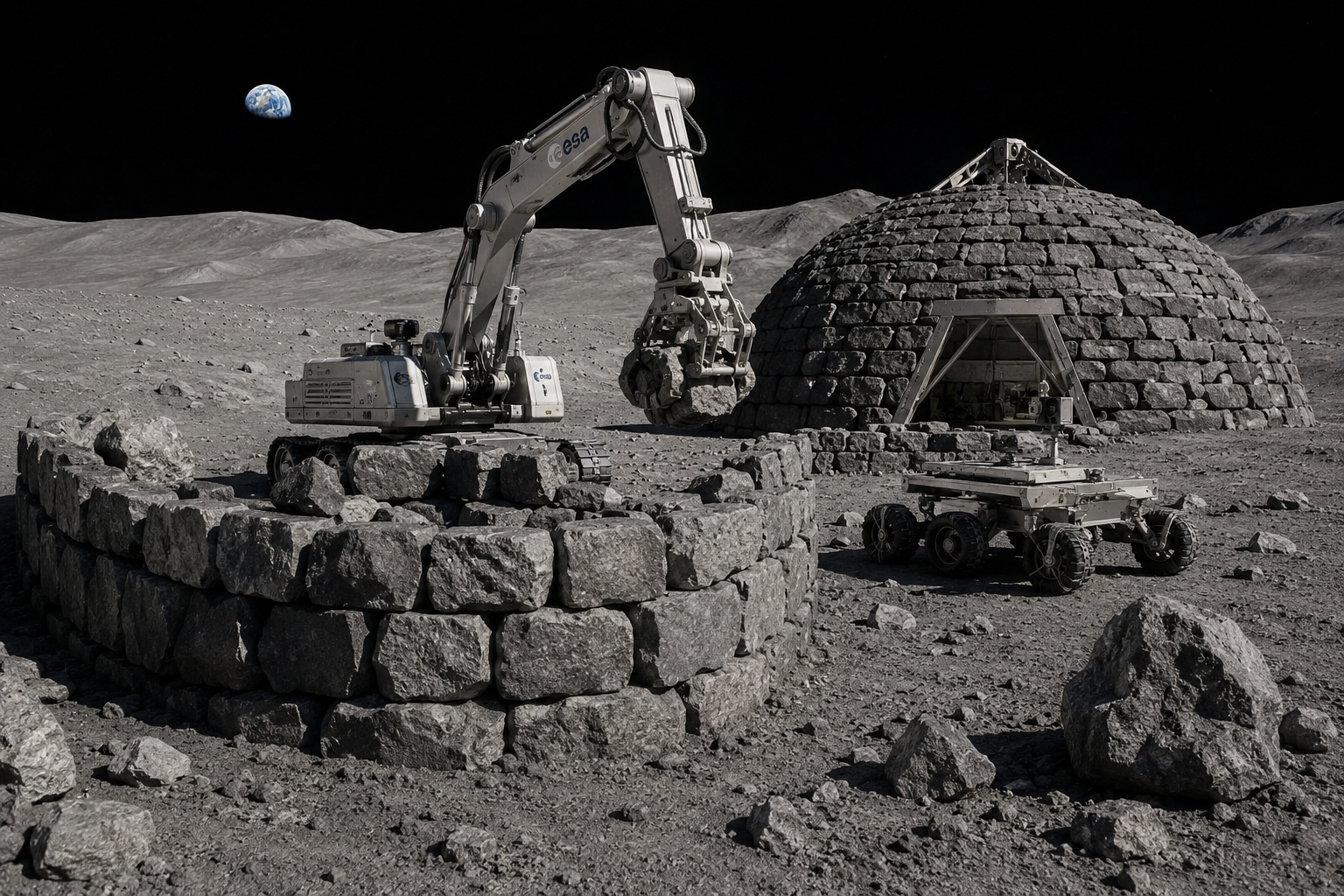
Building With Local Lunar Stones
Transporting construction material from Earth remains one of the major limits on large-scale lunar development. Because of this, many Moon base concepts rely on in-situ resource utilization, or ISRU, where local materials such as regolith, ice and solar energy are used to support surface operations.
Many ISRU construction proposals involve processing lunar soil into bricks, concrete-like composites or sintered building elements. These approaches may be effective, but they can require high temperatures, imported binders or complex manufacturing systems. The new study explores a lower-processing alternative: using naturally available stones without reshaping them into standard blocks.
This approach is closer to traditional dry-stone masonry, where irregular units are arranged carefully so that geometry, contact and gravity help maintain stability. On the Moon, such a method could reduce the need for heavy processing equipment and lower the energy required to construct protective walls, habitat supports, blast shields or other infrastructure.
A Computational Method for Irregular Stones
The researchers developed a computational design workflow that converts irregular stones into digital models, tests possible placements and generates a construction plan for robotic assembly. The system considers both geometric constraints and physical stability before adding each stone to the virtual structure.
In simple terms, the method works through an iterative process:
- Individual stones are digitally scanned or represented as 3D models.
- The target structure is defined, such as an arch, dome or wall.
- The algorithm tests possible positions and orientations for each stone.
- Candidate placements are checked for overlap, contact and packing density.
- Stability is verified using numerical simulation under lunar gravity.
- If the placement is stable, the stone is added to the assembly plan.
To make this process computationally efficient, the researchers encoded the stones and design space as 3D tensors. They then used discrete convolution to evaluate geometric features across many possible placements. This allowed the system to search for feasible positions more efficiently than testing each option manually.
Testing Arches, Domes and Walls
The study applied the method to three types of structures relevant to lunar construction: arches, domes and walls. These components are important because they appear in many Moon habitat and surface infrastructure concepts.
Arch-shaped structures
The researchers first tested four arch designs with an inner span of 0.8 meters. The algorithm successfully generated closed stone assemblies for all four cases. However, the stability tests showed an important limitation: placing each stone stably during construction did not guarantee that the final arch would remain stable as a whole.
In dry-joint simulations under lunar gravity, only two of the four arch designs remained stable after settlement. The other two collapsed because of hinge opening. This result shows that lunar stone construction must account not only for local stone placement, but also for the global stability of the finished structure.
Dome-shaped structure
The study also tested a larger dome-shaped design with a 2-meter span. The dome geometry combined a spherical lower section with a conic upper section. This was chosen because the arch tests showed that shallower inclinations can be difficult for stable stone placement.
To reduce computational cost, the dome was planned segment by segment. The researchers designed one quarter of the dome numerically and found that the planned structure achieved good interlocking between neighboring segments. The reported stone filling ratio was 0.62, showing that the method could create a dense assembly from irregular units.
Robotic wall construction
The most direct physical test was a wall-building experiment using a robotic masonry construction platform. The team scanned 150 irregular limestone pieces, generated a digital stock of available stones and used the algorithm to plan a layer-by-layer wall assembly.
The final wall measured 0.7 meters in length, 0.4 meters in width and 0.7 meters in height. A robotic arm assembled 138 stones over about 30 hours, while mortar was manually applied between layers to reduce the risk of instability during construction. Out of 138 stones, 132 were successfully placed by the robotic system, giving a placement success rate of 95%.
Why Energy Efficiency Matters
Energy demand is a central issue for lunar infrastructure. Manufacturing bricks or sintered regolith components may require significant power, especially if high-temperature processing is involved. The direct use of unprocessed stones could reduce that burden because the material does not need to be melted, cast or reshaped before use.
The study’s energy analysis indicates that dry-joint construction with unprocessed stones could require at least an order of magnitude less energy than approaches involving binders. Even when mortar-like binding material is included, the researchers found that using a high proportion of stones can still reduce energy demand compared with a structure made entirely from cast regolith.
This makes the method especially relevant for early lunar infrastructure, where power supply, construction time and robotic reliability may all be limited. Structures such as blast shields, protective barriers and support walls could benefit from a system that uses available surface material with minimal processing.
Important Limits and Open Questions
The study does not claim that unprocessed stones can solve every lunar construction challenge. The arch simulations show that dry-joint structures can face serious stability limits, especially when irregular stones create asymmetric load paths. Some structures may still need temporary scaffolding, thicker geometry, improved interlocking or adhesive joints.
The physical wall experiment was also performed in a terrestrial laboratory using limestone, mortar and a robotic arm. That means the method has not yet been tested on the Moon, with actual lunar rocks, lunar dust, vacuum conditions or operational constraints faced by surface robots.
Another important point is structural performance. The study focuses strongly on placement feasibility, packing density, stability checks and energy implications. Future work would need to compare different construction methods using performance-based metrics such as load-bearing capacity, durability, repairability and long-term behavior under lunar thermal cycling.
A Step Toward Robotic Moon Construction
The research shows that computational design can turn irregular stones into planned construction units rather than treating them as unusable material. By combining digital scanning, optimization and robotic placement, the method offers a possible path toward lower-energy lunar infrastructure.
For future Moon bases, the most practical construction systems may combine multiple approaches: processed regolith where precision is needed, unprocessed stones where mass and energy savings matter, and robotic systems capable of adapting to local terrain. This study adds an important option to that toolkit by showing how natural stone masonry could be planned and assembled for lunar surface construction.