

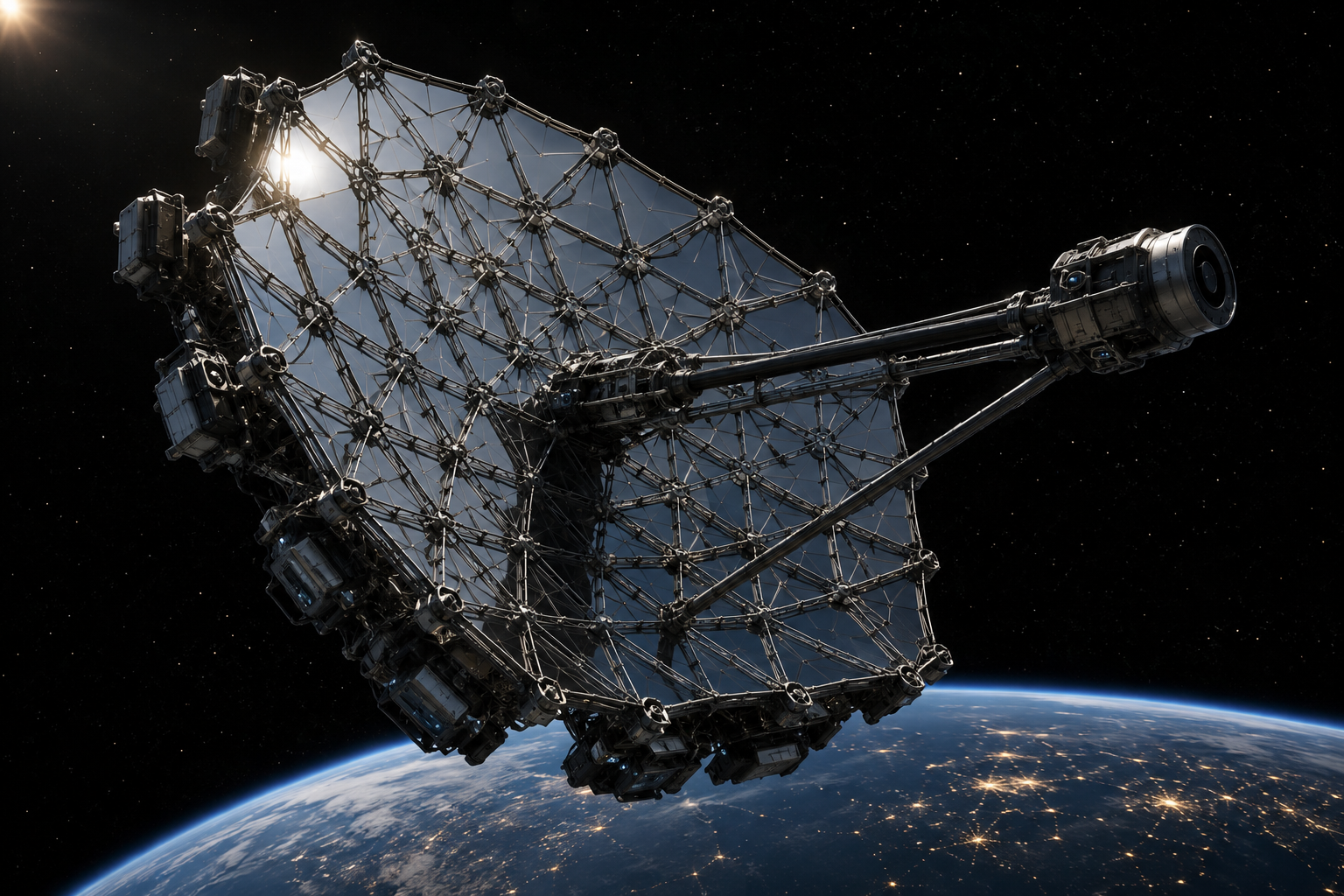
Future space infrastructure may need to do more than unfold after launch. It may need to adapt, repair itself, and change function after deployment. A new study in npj Space Exploration explores how a class of mechanical lattices known as Totimorphic structures could help make that possible through continuous, geometry-based reconfiguration.
The work introduces a computational framework that allows Totimorphic lattices to change their effective mechanical and optical properties without changing their material composition. Instead, the lattice is reprogrammed by adjusting its internal geometry, guided by automatic differentiation and objective-based optimisation.
What Are Totimorphic Structures?
Totimorphic lattices are mechanical structures built from repeating units of beams, levers, joints and springs. Their key feature is neutral stability: they can be moved into new shapes with actuation, but remain stationary when no external load is applied.
In simpler terms, these structures are designed so that their internal forces remain balanced across many configurations. This makes them interesting for space applications, where lightweight, adaptable and reusable systems are valuable.
The researchers focus on a specific challenge: how to continuously move a Totimorphic lattice from one valid configuration to another while preserving its structural rules. Earlier approaches could find target shapes, but did not always guarantee a smooth, physically valid path between configurations.
A Differentiable Framework for Reconfiguration
The study solves this by using generalised coordinates that absorb the geometric constraints of the lattice into the mathematical model. This allows the structure to be represented in a way that remains valid during optimisation.
The framework then uses automatic differentiation to minimise a task-specific cost function. In practical terms, that means the system can calculate how each joint or actuator should change to move the lattice toward a desired property, such as a target stiffness, shape or focal length.
The authors describe this as a route toward autonomous, lattice-aware control. A future physical system could, in principle, use sensor feedback and onboard computation to adjust itself in response to mission needs or damage.
Proof of Concept 1: Materials With Adjustable Mechanical Behaviour
The first simulation studied small-scale lattice structures with tunable mechanical properties. The researchers modelled how a Totimorphic lattice responds to compression and focused on its Poisson’s ratio, which describes how a material changes width when compressed.
A material with a positive Poisson’s ratio widens when compressed. A material with a negative Poisson’s ratio, known as an auxetic material, narrows under compression. The simulations showed that a 4 × 4 Totimorphic lattice could be continuously reconfigured toward both positive and negative target Poisson’s ratios.
This result suggests that future lattice-based space materials could adjust how they respond to stress. Such behaviour may be useful for adaptive panels, habitat components, tools, support structures or spacecraft parts that need different mechanical properties at different stages of a mission.
Proof of Concept 2: A Reconfigurable Space Telescope Mirror
The second proof of concept explored a larger-scale application: a deployable and reconfigurable telescope mirror. The researchers simulated a 6 × 6 Totimorphic lattice acting as the support structure for a reflective surface.
In the simulation, the lattice could move from a compact, collapsed configuration into an unfolded surface. This is important for space telescopes because launch vehicle fairings limit the size of rigid structures that can be sent into orbit.
After deployment, the same lattice could then reconfigure its surface shape to change the mirror’s focal point. The model demonstrated focal-length adjustment by guiding reflected light toward different target points. This could support adaptive optical systems that change imaging behaviour after launch.
Self-Repair Through Reconfiguration
The study also tested a simplified self-repair scenario. The researchers simulated damage to one mirror element by adding a deflection to the light reflected from that unit. The lattice was then reconfigured to compensate for the defect.
For smaller amounts of simulated damage, reconfiguration could return the mirror close to its original performance. For stronger damage, the system still improved performance but could not always fully restore the baseline state.
This does not mean that a real self-repairing telescope has been built. The result is a simulation-based proof of concept. However, it shows how reconfigurable structures could potentially reduce the impact of local damage, such as defects caused by micrometeoroids.
Why This Matters for Space Infrastructure
Space missions face strict limits on mass, volume, energy and repair access. Structures that can launch compactly, deploy reliably and later change function could offer major advantages for long-duration missions.
Totimorphic lattices may sit between flexible deployables, such as membranes or inflatables, and more rigid systems, such as origami-inspired structures. They could provide load-bearing capability while still allowing repeated, controlled reconfiguration.
The researchers note possible future applications beyond telescope mirrors, including space antennas, solar sails, spacecraft components and adaptive habitat materials.
Important Limitations
The study remains computational and conceptual. Several engineering challenges must be addressed before Totimorphic space structures can become practical hardware.
- Real beams and levers will deform rather than behave as perfectly rigid components.
- Physical joints may experience friction, jamming and cold welding in vacuum.
- Actual springs may not perfectly reproduce the ideal zero-length behaviour assumed in the model.
- Large structures may require many actuators, increasing complexity and failure risk.
- More advanced collision detection and manufacturable designs are needed for three-dimensional systems.
The authors also highlight that reducing the number of actuators will be important because each actuator can become a potential failure point in spacecraft systems.
A Step Toward Adaptive Space Systems
The study presents Totimorphic structures as a promising theoretical foundation for reprogrammable space infrastructure. By combining mechanical lattice design with differentiable optimisation, the framework offers a way to calculate not only final shapes, but also continuous paths between valid configurations.
If future prototypes can overcome the practical challenges of materials, actuation, friction and space-environment durability, such structures could help spacecraft, telescopes and habitats become more adaptive after deployment. For now, the work provides a simulation-based roadmap for how space systems might one day change shape, tune their properties and partly compensate for damage without direct human intervention.