

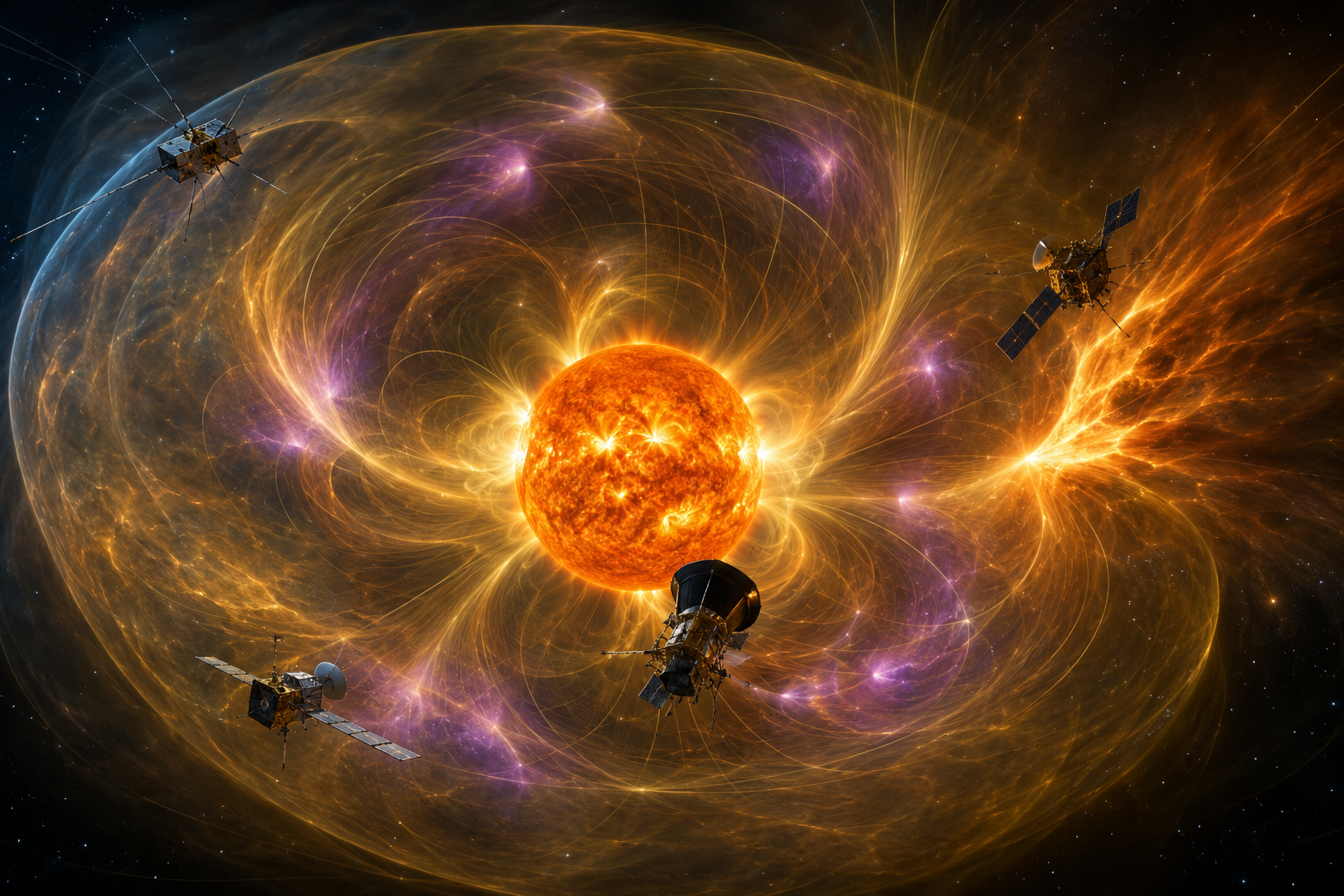
A team of researchers has reported an unprecedented solar radio event that persisted for nearly 19 days, setting a new duration record for a hectometric Type IV radio burst. The phenomenon was observed between August 21 and September 9, 2025, by multiple spacecraft positioned throughout the inner Solar System, providing a unique opportunity to study the long-term evolution of energetic particles trapped within the Sun’s extended magnetic environment.
The study suggests that the radio emission originated from a vast, long-lived reservoir of electrons confined within large coronal magnetic structures associated with helmet streamers and coronal mass ejections (CMEs). The observations offer new clues about how solar eruptions can maintain energetic particle populations over extended periods and may improve future space weather forecasting capabilities.
A Record-Breaking Solar Radio Event
Type IV radio bursts are broadband radio emissions produced by energetic electrons trapped within magnetic structures in the solar corona. These events typically last from minutes to several hours, while only a handful have persisted for multiple days.
The newly reported event far exceeded previous records. Researchers tracked the radio continuum across three successive visibility windows as the source rotated with the Sun. The emission was detected first by Solar Orbiter, later by Wind and Parker Solar Probe, and finally by STEREO-A as solar rotation brought the source region into favorable viewing positions.
The continuity of the signal across multiple spacecraft strongly indicates that the same corotating source remained active throughout the entire observation period.
Observed Across the Solar System
The event was monitored using radio instruments aboard four spacecraft:
- Solar Orbiter
- Wind
- Parker Solar Probe
- STEREO-A
These spacecraft occupied different heliocentric longitudes and distances, allowing scientists to follow the radio source as the Sun rotated.
Measurements revealed radio emission between approximately 0.5 and 3 MHz. During the final observation window, STEREO-A detected extremely strong circular polarization, with polarization values approaching 90% or greater. Such high polarization suggests that the radio emission was dominated by a single magnetoionic propagation mode.
Evidence for a Giant Electron Reservoir
The researchers interpret the observations as evidence of a large reservoir of energetic electrons trapped within extended coronal magnetic structures.
Analysis indicates that the source existed at heliocentric distances of roughly 6 to 10 solar radii from the Sun. Independent techniques used in the study suggest that the emitting region possessed a transverse diameter of approximately 2.5 to 3 solar radii.
This scale is consistent with large streamer-top structures or CME-related magnetic cavities capable of storing energetic particles for extended periods.
Role of Coronal Mass Ejections
Three fast coronal mass ejections erupted from the same solar sector during the event. The study proposes that these eruptions may have helped sustain the radio source by reorganizing the magnetic environment and continually replenishing trapped electrons.
The CMEs occurred on:
- August 21, 2025
- August 30, 2025
- September 4, 2025
Researchers suggest that repeated magnetic restructuring and ongoing electron injections allowed the reservoir to survive for nearly three weeks.
Quasi-Periodic Pulsations Offer Additional Clues
The radio signal also exhibited repeating intensity variations known as quasi-periodic pulsations. These oscillations occurred roughly every 45 to 60 minutes.
The team interprets these pulsations as signatures of magnetohydrodynamic (MHD) waves oscillating within the giant magnetic trap. Using magnetoseismology techniques, the researchers independently estimated the size of the source region, obtaining values consistent with those derived from solar rotation measurements.
The agreement between the two methods strengthens the interpretation of a large-scale, long-lived coronal structure.
New Localization Method Introduced
The study also introduces a new technique called the Wavevector-Corrected Ray Sphere (WCRS) method.
Low-frequency solar radio waves are strongly affected by scattering and refraction as they travel through the solar wind, making accurate source localization difficult. WCRS applies corrections for these propagation effects and combines them with coronal density models to estimate source locations from a single spacecraft.
The method placed the radio source near a helmet streamer, consistent with the broader interpretation of a large coronal electron reservoir.
Implications for Space Weather Forecasting
Beyond explaining this extraordinary event, the researchers believe the new localization technique could have practical value for operational space weather forecasting.
The same approach may eventually be used to track CME-driven shocks associated with Type II radio bursts and to identify magnetic connectivity paths revealed by Type III radio bursts. Such capabilities could improve monitoring of solar activity and help predict conditions that affect satellites, communications systems, navigation services, and power infrastructure on Earth.
Looking Ahead
The nearly 19-day radio burst represents the longest reported hectometric Type IV continuum observed to date. The event demonstrates that large-scale solar magnetic structures can sustain energetic electron populations far longer than previously documented.
Future missions and planned low-frequency radio observatories may provide direct imaging of similar events, helping scientists determine how these reservoirs form, evolve, and influence the heliosphere. The study also highlights the importance of coordinated multi-spacecraft observations for understanding the complex relationship between solar eruptions, magnetic fields, and energetic particles throughout interplanetary space.