

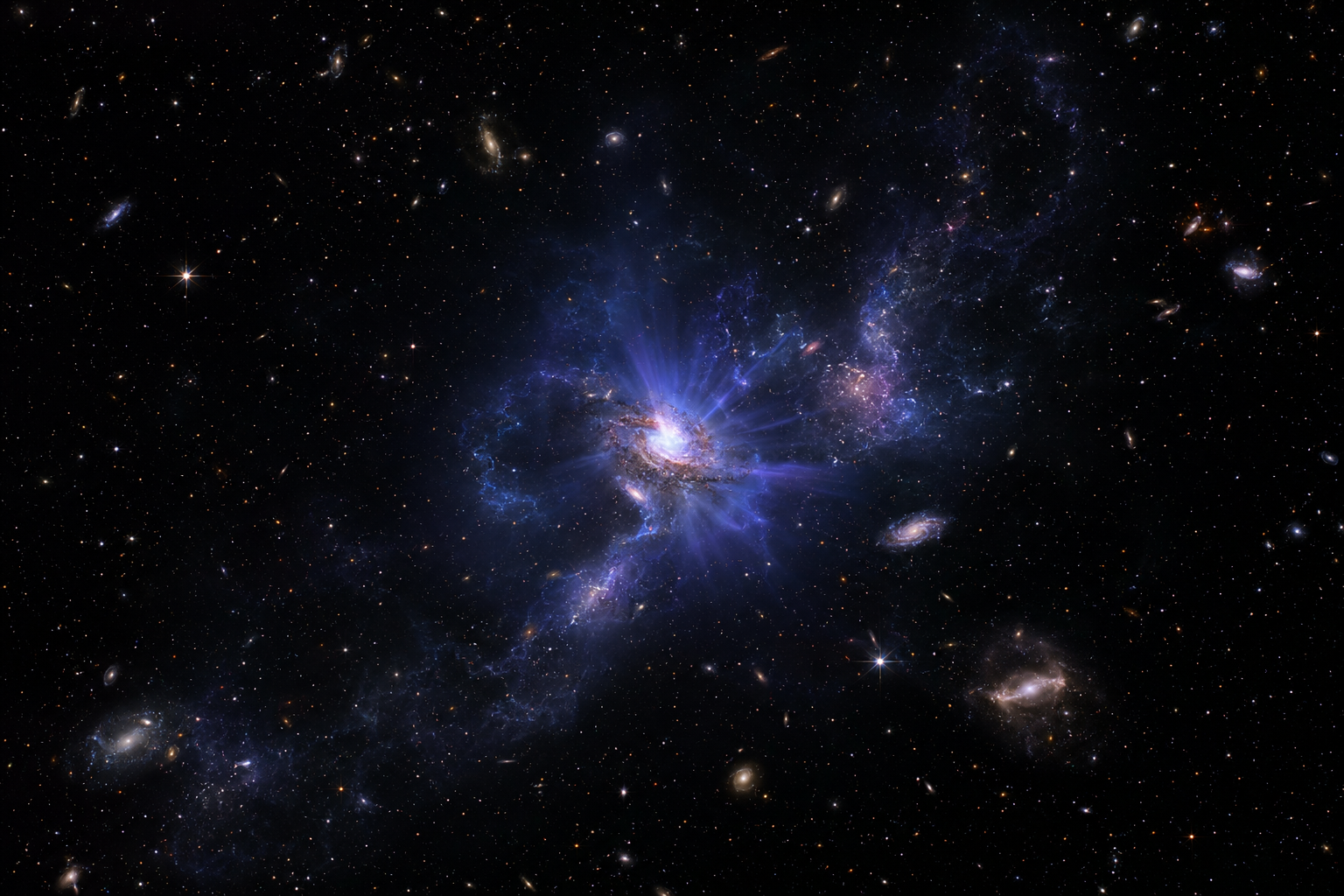
Astronomers have identified a rare candidate galaxy that appears to leak Lyman continuum radiation, the high-energy ultraviolet light capable of ionizing neutral hydrogen. The object, named LCEz4-M1, lies at a redshift of 4.444 in the Hubble Ultra Deep Field and may provide an important clue to how early galaxies helped transform the Universe after the cosmic dark ages.
A rare signal from the early Universe
Lyman continuum photons have wavelengths shorter than 912 angstroms. These photons are central to the study of cosmic reionization, the period when the mostly neutral hydrogen between galaxies became ionized. Directly detecting such radiation from distant galaxies is difficult because the intergalactic medium absorbs much of it before it reaches Earth.
The research team reports that LCEz4-M1 is among the highest-redshift Lyman continuum emitter candidates currently known. Its distance places it closer to the era when early galaxies were changing the state of the Universe, making the detection scientifically valuable even though the object remains classified as a candidate.
How the galaxy was identified
The redshift of LCEz4-M1 was determined from a Lyman-alpha emission line detected in observations from the Multi Unit Spectroscopic Explorer, or MUSE, on the European Southern Observatory’s Very Large Telescope. The source is located in the Hubble Ultra Deep Field, one of the most deeply observed regions of the sky.
The study combines data from VLT/MUSE, the Hubble Space Telescope and the James Webb Space Telescope. Hubble’s ACS/F435W image detected the possible Lyman continuum signal at about 3.7 sigma, while the MUSE spectrum and narrowband imaging found an independent signal at about 2.8 to 3.0 sigma.
Why the detection matters
If confirmed, LCEz4-M1 could help astronomers understand how ionizing radiation escaped from young galaxies. This process is essential because galaxies are considered the main source of the photons that reionized the early Universe.
The researchers estimate conservative lower-limit escape fractions of about 0.82 from the Hubble F435W measurement and about 0.75 from the MUSE data, assuming maximum intergalactic medium transmission. These high values suggest that a large fraction of ionizing photons may be escaping from the galaxy, although the exact fraction remains model-dependent.
Not a simple starburst case
One notable result is that LCEz4-M1 does not clearly resemble a classic extreme compact starburst under the team’s preferred JWST-only interpretation. The galaxy appears compact, but its current star formation surface density is moderate, about 0.38 solar masses per year per square kiloparsec.
The study also finds relatively weak optical emission lines, low Lyman-alpha equivalent width and a recent star formation history that may be declining. Together, these features suggest that LCEz4-M1 may be in a postburst phase, where earlier stellar activity opened pathways through the surrounding gas, allowing ionizing photons to escape later.
A possible companion and dense environment
JWST imaging shows a faint nearby companion candidate about 0.5 arcseconds from LCEz4-M1. If physically associated, it could indicate a minor interaction. The authors also note that the galaxy may lie in a locally overdense region, although the current evidence is not strong enough to confirm a protocluster environment.
What comes next
The authors caution that deeper spectroscopy is needed to confirm the nature of the source and better understand the conditions allowing such strong Lyman continuum escape. Future wide and deep surveys, including those from the Chinese Space Station Survey Telescope and its Multi-Channel Imager, may help identify larger samples of similar galaxies.
LCEz4-M1 is important because high-redshift Lyman continuum detections are rare. If its signal is confirmed, it could become a useful laboratory for studying how early galaxies released the radiation that helped illuminate and ionize the young Universe.