

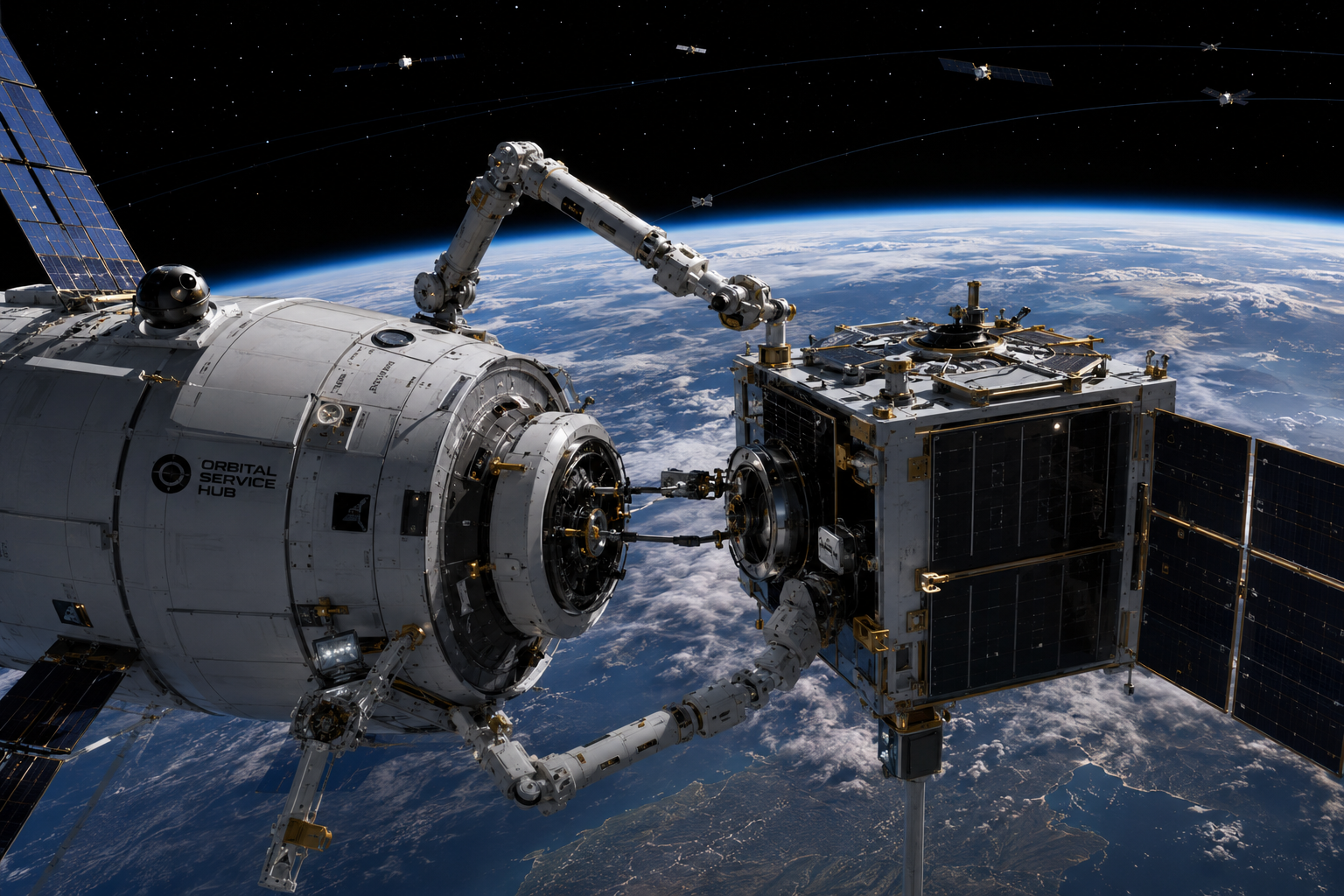
On-Orbit Servicing Gains Attention as Satellite Numbers Surge
The rapid expansion of small satellite constellations in low Earth orbit (LEO) is increasing pressure on the long-term sustainability of space operations. A new perspective article published in npj Space Exploration explores how on-orbit servicing technologies could help extend satellite lifetimes, reduce orbital debris, and lower replacement costs for operators.
The authors note that the global space economy, currently valued at approximately $600 billion, is projected to reach nearly $1.8 trillion by 2035. Much of this growth is being driven by the deployment of thousands of small and medium satellites for communications, Earth observation, navigation, and broadband internet services.
According to the paper, most small satellites today are effectively single-use systems. Once hardware failures occur or fuel is depleted, satellites are often deorbited and replaced entirely. This replacement cycle contributes to increasing congestion in LEO and raises concerns about long-term orbital sustainability.
Satellite Constellations Continue Expanding Rapidly
The paper highlights the rapid growth of satellite constellations operated by both government and commercial organizations. Systems such as Starlink, Project Kuiper, OneWeb, Guowang, and IRIS² are expected to place tens of thousands of additional satellites into orbit over the coming years.
The authors state that this increase in orbital infrastructure creates a strong case for developing servicing systems capable of:
- Refuelling satellites in orbit
- Replacing damaged modules
- Performing repairs
- Upgrading payloads
- Supporting controlled deorbiting
The study argues that maintaining satellites instead of frequently replacing them could significantly reduce launch cadence and operational costs while improving constellation resilience.
Historical Foundations of Orbital Servicing
The article reviews several important milestones in the history of orbital servicing. These include NASA’s 1984 Solar Maximum Mission repair and the multiple Space Shuttle servicing missions that upgraded the Hubble Space Telescope between 1993 and 2009.
More recent demonstrations have increasingly focused on robotic and autonomous operations. Japan’s ETS-VII mission demonstrated robotic docking capabilities in 1997, while the Orbital Express mission in 2007 tested autonomous refuelling and component exchange technologies.
The paper also discusses newer commercial servicing programs such as Northrop Grumman’s Mission Extension Vehicle (MEV), Astroscale’s ELSA missions, ESA-backed ClearSpace-1, and upcoming Tetra refuelling demonstrations planned for 2026 and 2027.
Core Technologies Needed for Small Satellite Servicing
The authors identify several technologies that could become essential for scalable servicing of small satellite constellations.
Modular Satellite Architectures
The paper recommends designing future satellites with replaceable subsystems and standardized service interfaces. Components such as propulsion units, communication systems, payload modules, and power systems could potentially be swapped or upgraded in orbit.
Standardized Docking Interfaces
Standardized mechanical and electrical interfaces are described as critical for interoperability between satellites and servicing vehicles. The authors suggest that common docking systems, alignment guides, and machine-readable fiducials could simplify autonomous servicing operations across different satellite platforms.
Autonomous Rendezvous and AI
The study emphasizes the importance of artificial intelligence and autonomous navigation systems for future servicing missions. AI systems could support real-time fault detection, predictive maintenance, collision avoidance, and autonomous docking operations while still allowing human supervision during high-risk procedures.
In-Orbit Manufacturing and Repair
The article also explores the future role of additive manufacturing and advanced repair materials in space. The authors discuss how compact in-space manufacturing systems could produce spare components, repair panels, or structural elements directly in orbit, reducing the need for launching replacement hardware from Earth.
Economic and Environmental Considerations
The paper argues that on-orbit servicing could eventually shift the satellite industry from a replacement-based model toward a service-based orbital economy. Instead of treating satellites as disposable hardware, operators could maintain and upgrade systems over extended operational lifetimes.
The authors also highlight environmental concerns associated with the increasing number of satellite launches and atmospheric reentries. The paper cites projections suggesting that approximately 29 tons of satellites could re-enter Earth’s atmosphere each day in the future if current deployment trends continue.
Reducing the frequency of replacement launches could help mitigate debris risks, lower atmospheric pollution from rocket launches and satellite burnups, and reduce the probability of cascading orbital collisions known as the Kessler syndrome.
Legal and Governance Challenges Remain
The paper notes that orbital servicing introduces complex legal and ethical questions. Since outer space is not sovereign territory, issues involving satellite access, servicing authorization, liability, and dual-use technologies remain unresolved.
The authors argue that future servicing frameworks may require international authorization systems, operational transparency standards, and secure verification protocols to prevent misuse of servicing technologies.
Outlook for the Next Decade
The article concludes that orbital servicing could become a foundational component of the future space economy if technical, regulatory, and commercial challenges are addressed. The authors call for coordinated development of universal servicing standards, autonomous servicing demonstrations, AI-enabled operations, and in-space manufacturing infrastructure.
According to the paper, achieving these goals could support a more sustainable, resilient, and upgradeable satellite ecosystem throughout low Earth orbit in the coming decades.