

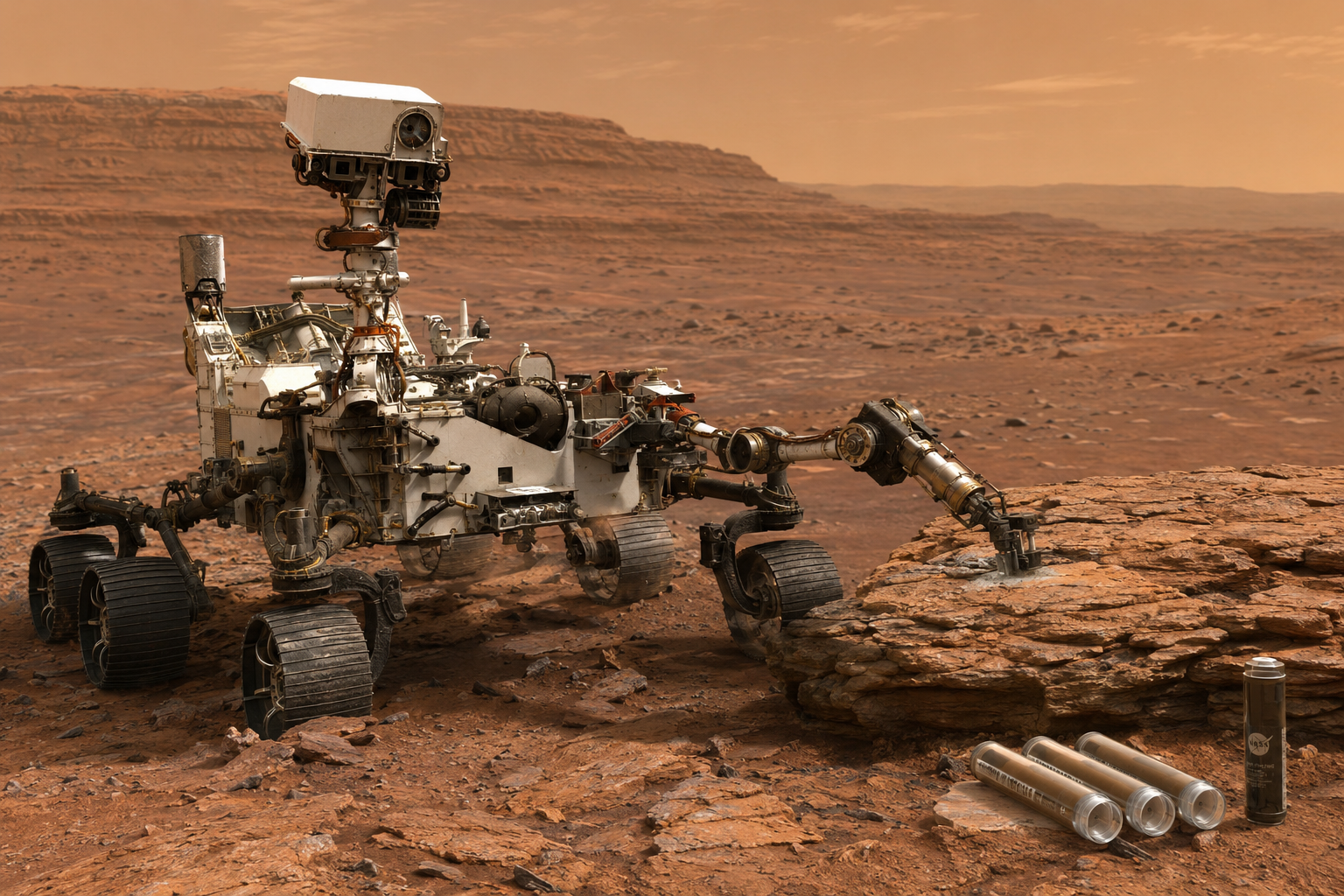
NASA’s Perseverance rover is building one of the most scientifically valuable collections ever assembled beyond Earth: sealed samples of Martian rock, regolith, and atmosphere from Jezero Crater. If future missions return these materials to Earth, scientists could study them in advanced laboratories to investigate Mars’ ancient environment, its geological history, and whether the planet may once have supported microbial life.
Why Mars Samples Matter
For decades, spacecraft have studied Mars from orbit and from the surface. Rovers have revealed ancient river channels, lake beds, minerals shaped by water, and rocks that record a complex planetary past. But even the most capable rover instruments are limited by mass, power, and the harsh conditions of operating on another planet.
Returning carefully selected samples to Earth would allow scientists to use laboratory instruments far more powerful than anything that can currently be sent to Mars. These tools could examine the rocks at microscopic and chemical levels, search for subtle organic signatures, determine precise ages, and compare Martian materials with meteorites and terrestrial rocks.
Jezero Crater: A Former Lake Environment
Perseverance landed in Jezero Crater in February 2021 because the site preserves evidence of an ancient lake and river delta. On Earth, deltas are important geological environments because flowing water can transport minerals, sediments, and organic material, then bury and preserve them for long periods.
That makes Jezero Crater a key target in the search for ancient habitable conditions on Mars. NASA scientists do not claim that the samples prove life existed there. Instead, the samples may preserve clues that can help researchers test whether ancient Mars had the right conditions for microbial life and whether any possible biosignatures are present.
A Diverse Collection of Martian Materials
The Perseverance sample collection includes several types of material, each with a different scientific purpose. Sedimentary rocks are especially important because they can preserve records of ancient water activity and, potentially, signs of past life. Igneous rocks can help scientists understand volcanic activity, crust formation, and the early evolution of Mars. Regolith samples can reveal information about the local and global Martian surface environment.
NASA’s 2023 video highlighted that Perseverance had already collected a scientifically selected set of samples at that stage. Since then, the rover has continued expanding the collection as it explores new terrain, including materials from the crater rim region.
What Scientists Hope to Learn
Returned Mars samples could help answer several major questions in planetary science:
- Did ancient Mars ever host microbial life?
- How long did water persist in Jezero Crater?
- What chemical conditions existed in ancient Martian lakes and rivers?
- How did Mars evolve from a wetter planet into the cold, dry world seen today?
- What can Martian rocks reveal about the early history of rocky planets, including Earth?
Earth’s oldest rock record has been heavily altered by plate tectonics, erosion, and biological activity. Mars, by contrast, preserves ancient surfaces that may date back billions of years. Studying those rocks could therefore help scientists compare the early histories of Mars and Earth.
The Role of Mars Sample Return
The long-term goal is to bring selected samples back to Earth through a Mars Sample Return campaign involving NASA and the European Space Agency. The mission architecture has been under review, with NASA announcing in January 2025 that it would study two possible landing approaches before selecting a final path forward.
The scientific goal remains clear: deliver sealed Martian samples to Earth so researchers can examine them in controlled laboratories. Such a return would mark the first time samples collected from another planet are brought to Earth for detailed study.
A Scientific Archive for Future Generations
One of the most important aspects of returned samples is that they would not be studied only once. Like Apollo lunar samples, Martian materials could be preserved for decades, allowing future scientists to apply new techniques that do not yet exist. The samples could become a long-term scientific archive for planetary science, astrobiology, and human exploration planning.
Perseverance’s work in Jezero Crater is therefore not just a rover mission. It is the first stage of a broader effort to bring part of Mars into Earth’s laboratories, where the Red Planet’s rocks may help answer whether life ever emerged beyond Earth and how rocky planets evolve over billions of years.