

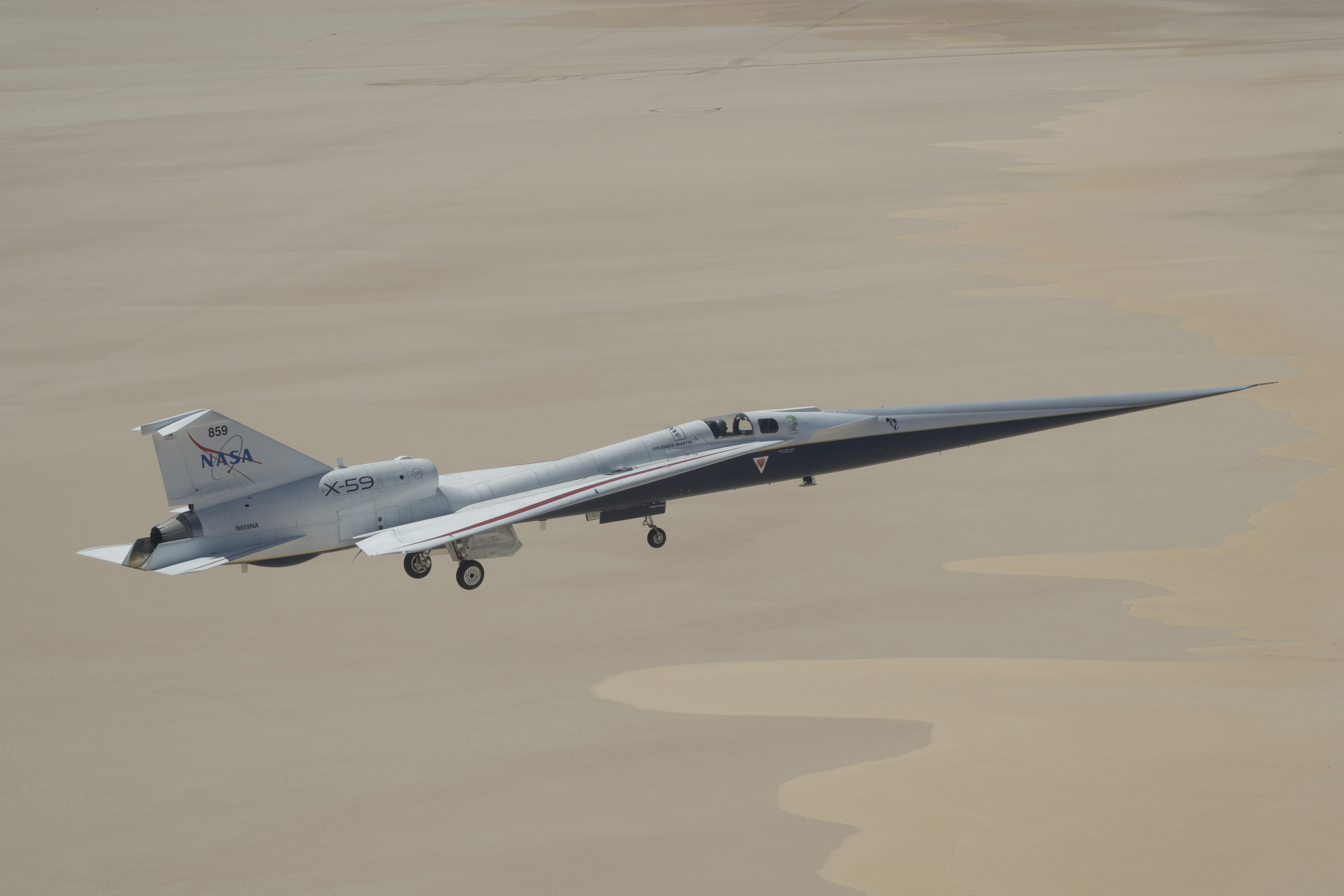
NASA’s X-59 quiet supersonic research aircraft is entering a critical new phase of flight testing as engineers prepare the experimental aircraft for its first-ever supersonic flights. The milestone marks a major step forward for NASA’s Quesst mission, which aims to demonstrate that aircraft can travel faster than the speed of sound while producing a significantly quieter sonic signature than conventional supersonic jets.
Following months of flight testing and system evaluations, the X-59 team has completed an initial series of flights and is now preparing to expand the aircraft’s flight envelope to higher speeds and altitudes. These upcoming flights will provide essential data on how the aircraft performs under the operational conditions for which it was specifically designed.
X-59 Approaches Its First Supersonic Flights
NASA expects the X-59 to exceed the speed of sound for the first time during a series of test flights conducted at approximately 43,000 feet. Flying faster than 630 mph, the aircraft will cross a threshold that represents years of design, engineering, and development work.
Following that achievement, the aircraft is scheduled to perform a mission-conditions flight, reaching Mach 1.4, or roughly 925 mph, at an altitude of about 55,000 feet. These conditions represent the target operating environment required for future community overflight demonstrations.
The mission-conditions flights are particularly important because they replicate the speed and altitude profile NASA plans to use when the X-59 eventually flies over populated areas to collect public feedback on its unique low-boom acoustic signature.
Designed to Replace the Sonic Boom with a Quiet Thump
Traditional supersonic aircraft generate powerful shock waves that merge into a loud sonic boom, often heard as an explosive sound on the ground. The X-59 was specifically designed to reshape those shock waves into a softer and less disruptive acoustic event often referred to as a "quiet sonic thump."
Although the aircraft is approaching its first supersonic flights, NASA notes that these early tests are not intended to validate its quiet-flight capability. During the current phase, the X-59 will fly alongside a conventional supersonic chase aircraft whose sonic booms will dominate the acoustic environment.
The chase aircraft will also carry specialized instrumentation capable of measuring the X-59’s shock wave characteristics, providing engineers with valuable preliminary data before more detailed acoustic testing begins later in the mission.
Progress Made During Initial Flight Testing
The X-59 first flew in October 2025 before entering a planned maintenance period. Since returning to flight operations in March 2026, the aircraft has completed 15 flights, steadily expanding its performance envelope.
- Successfully retracted its landing gear in flight for the first time.
- Reached altitudes of up to 43,000 feet.
- Accelerated to Mach 0.95, approaching supersonic speed.
- Completed multiple dual-flight test days.
- Transitioned between high-speed and low-speed test regimes to evaluate aircraft behavior across different flight conditions.
Engineers used the flights to assess the performance of numerous onboard systems, including fuel management, hydraulics, environmental controls, and the aircraft’s innovative eXternal Vision System (XVS).
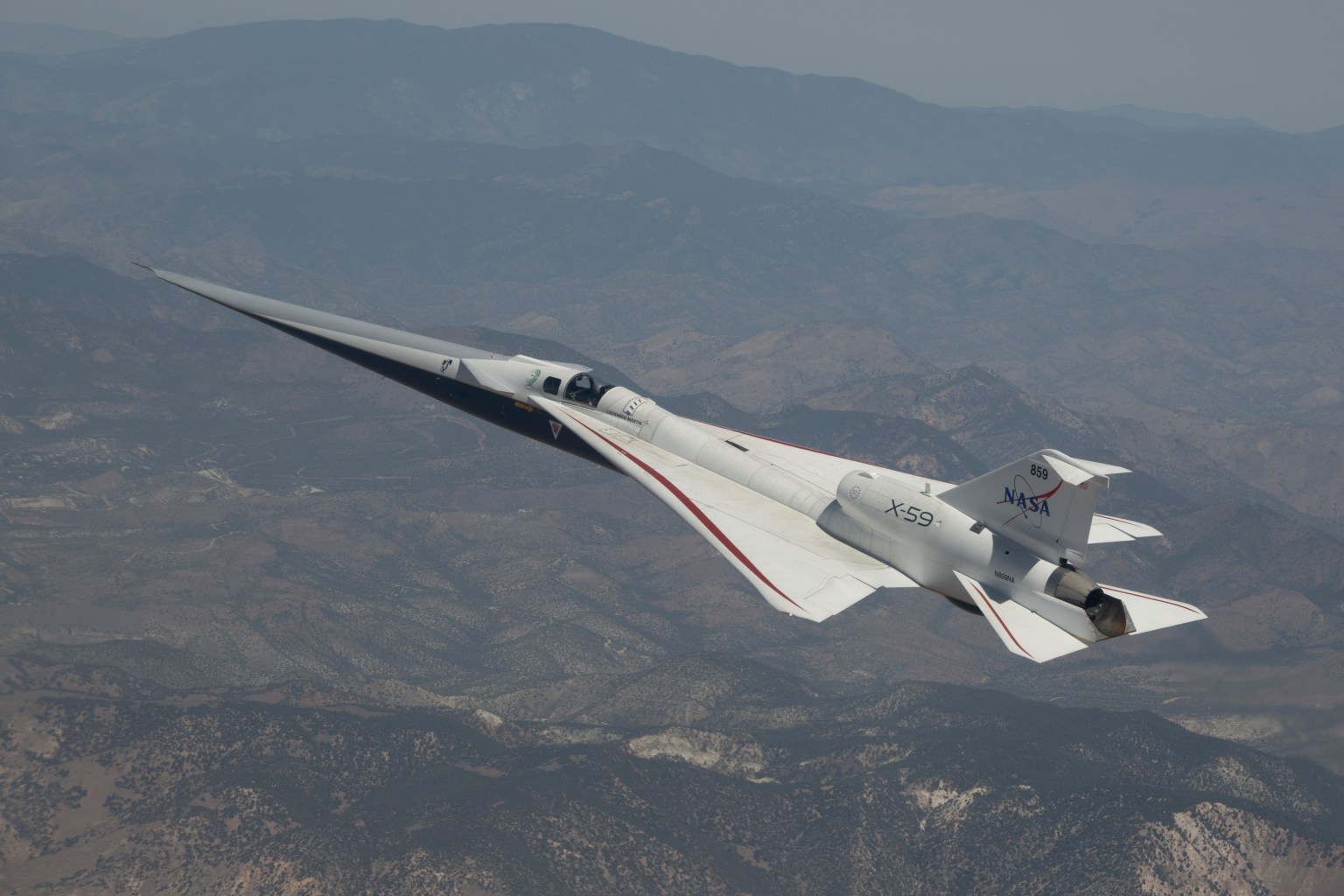
Unlike conventional aircraft, the X-59 has no forward-facing cockpit windshield. Instead, pilots rely on a sophisticated combination of cameras and displays that provide a real-time forward view. The flight campaign has allowed engineers to evaluate the effectiveness of this unique system under operational conditions.
Testing the Aircraft at Its Design Limits
The upcoming flight campaign will continue expanding the aircraft’s capabilities. Beyond reaching Mach 1.4 at mission conditions, NASA plans to push the X-59 to its maximum design performance.
- Maximum speed: Mach 1.6 (approximately 1,218 mph)
- Maximum altitude: 60,000 feet
- Mission-condition speed: Mach 1.4 (approximately 925 mph)
- Mission-condition altitude: 55,000 feet
Not every flight will be conducted at supersonic speeds. Engineers will continue flying the aircraft under a variety of subsonic and lower-altitude conditions to collect performance data across a broad operational envelope.
Preparing for Quesst Phase 2
All current flights are part of Phase 1 of NASA’s Quesst mission, which focuses on verifying the aircraft’s performance, safety, and airworthiness.
Data gathered during the upcoming supersonic flights will help prepare engineers for Phase 2, expected to begin later in 2026. During that stage, NASA will conduct detailed measurements of the X-59’s acoustic signature to verify that it is producing the low-boom characteristics predicted by its design.
Those results will form the foundation for future community response studies, where residents beneath the aircraft’s flight path will be asked to provide feedback on the sound they hear.
A Step Toward Future Supersonic Travel
The X-59 represents one of NASA’s most ambitious aviation research programs in decades. If successful, the aircraft could provide regulators with the data needed to reconsider restrictions on commercial supersonic flight over land, potentially opening the door to a new generation of faster passenger aircraft.
As the aircraft prepares to exceed the speed of sound for the first time, NASA engineers see the moment as more than a technical achievement. It is a key step toward demonstrating a future where supersonic travel may once again become practical, but with far less noise impact on communities below.