

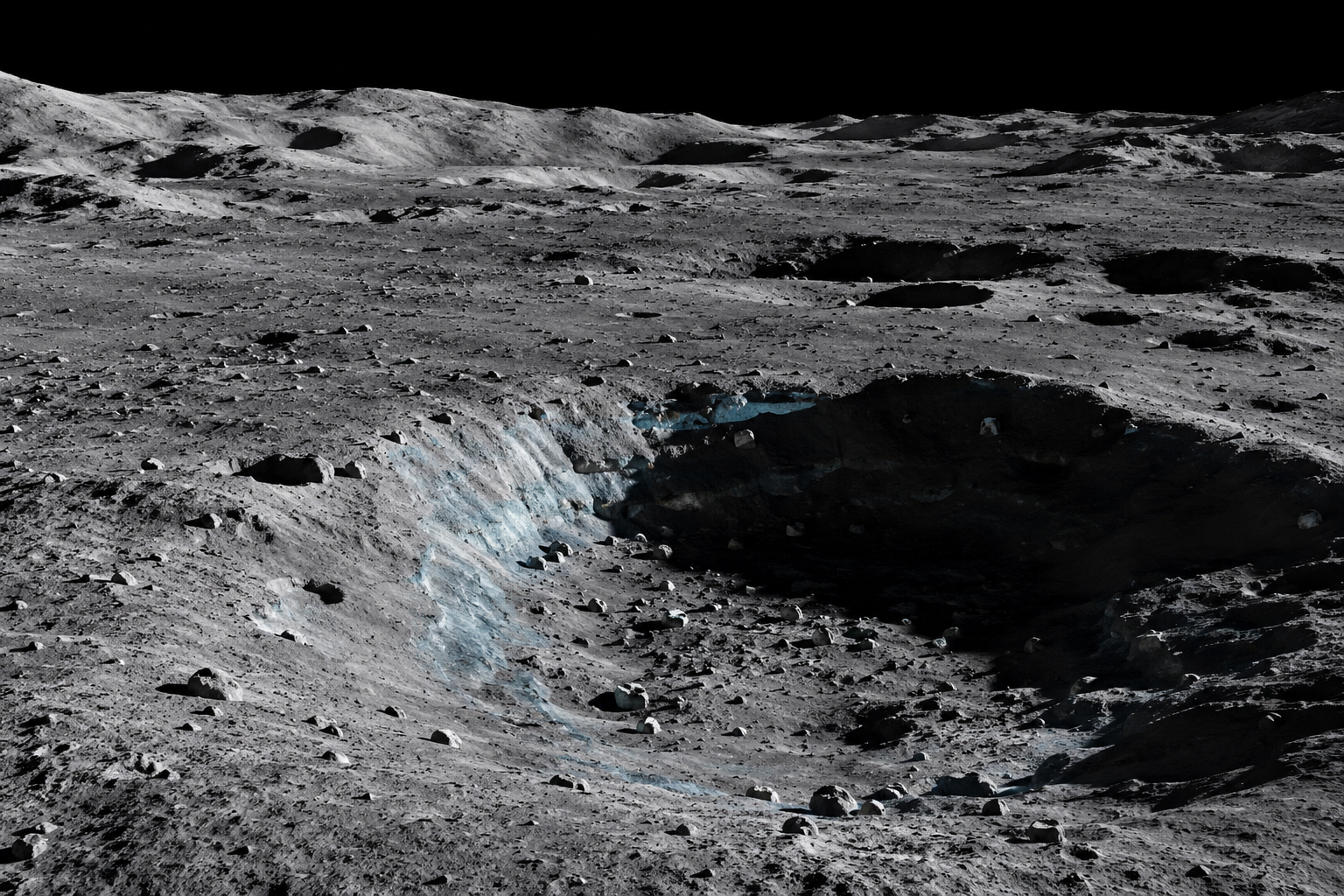
The Moon’s south pole is one of the most important targets for future lunar exploration because its permanently shadowed regions may preserve water ice for billions of years. A new study published in npj Space Exploration examines how impacts into these dark, cold regions may have disturbed, buried, or redistributed shallow ice deposits over time.
The research focuses on permanently shadowed regions, or PSRs, between 85° and 90° south latitude. These areas remain hidden from direct sunlight, allowing temperatures to stay low enough for water ice and other volatile materials to survive. However, the same regions have also been struck repeatedly by impactors, raising an important question: how much of the ice has remained undisturbed?
Mapping Craters Inside Lunar Cold Traps
The research team mapped craters inside south polar PSRs using high-resolution lunar imagery, including observations from ShadowCam aboard the Korean Pathfinder Lunar Orbiter and the Orbiter High Resolution Camera on Chandrayaan-2. The study also used lunar topographic information to focus on flatter PSR regions with slopes below 15°, excluding steep crater walls and ridges where surface movement could complicate the analysis.
Within the selected PSRs larger than 1 square kilometre, the team identified about 87,452 craters ranging from 5 metres to 7 kilometres in diameter. To better estimate the population of smaller craters, the researchers developed a small-scale crater population model using detailed mapping from the Connecting Ridge region near the lunar south pole.
That model suggests that around 24 million craters between 1 and 20 metres wide may exist within the studied PSRs. These small craters are estimated to cover roughly 1,280 square kilometres, or about 26% of the analysed PSR area. In contrast, about 74% of the same region appears unaffected by direct impacts from these smaller craters.
Impact Gardening Could Both Damage and Preserve Ice
Although much of the PSR surface may not have been directly hit by small craters, the study notes that these regions are still affected by impact gardening. This process occurs when impacts churn, mix, and redistribute the upper lunar regolith over long periods.
For lunar ice, impact gardening is a double-edged process. It can expose buried ice to vacuum, where it may be lost through sublimation. At the same time, ejecta from impacts can also bury ice again, protecting it from direct exposure and helping it survive beneath the surface.
The study estimates that small craters may have excavated about 452 million kilograms of ice from shallow buried layers within the south polar PSRs between 85° and 90°S. This estimate is based on assumptions tied to previous LCROSS impact observations, so it should be treated as a model-based result rather than a direct measurement of current ice abundance.
Simulations Show How Impacts May Move Ice
To test how impacts could affect buried ice, the researchers used iSALE-2D impact simulations under PSR-like conditions. The simulations considered small crater-forming impacts as well as larger impact scenarios involving shallow ice layers beneath the lunar surface.
The results suggest that smaller craters around 1 metre in diameter can disturb near-surface ice and mix it with regolith. Larger impacts, especially craters wider than 200 metres, may excavate and redistribute shallow ice more strongly. In these larger cases, some ice may be lost from the crater cavity, while some material may be transported and buried near the crater rim or inside nearby cold traps.
This means that lunar polar ice may not be stored as a simple, untouched layer. Instead, it may exist in a more complex pattern shaped by impact history, burial, excavation, and repeated regolith mixing.
Why This Matters for Future Moon Missions
The findings are relevant to future lunar missions that aim to study or use water ice near the Moon’s south pole. Missions such as Chandrayaan-5/LUPEX and other planned robotic and human exploration efforts may need to consider not only where PSRs exist, but also how impact history has altered the ice within them.
Crater-free or less directly impacted PSR surfaces may still contain mixed or buried ice affected by nearby ejecta. These areas could become important targets for rovers, drills, and instruments designed to study the Moon’s volatile inventory.
The study also highlights an important uncertainty: the exact depth, concentration, and stratigraphy of lunar polar ice remain unresolved. While simulations and remote sensing indicate that ice may exist in quantifiable amounts, direct in-situ measurements will be needed to confirm how much ice is present and how it is distributed below the surface.
A More Dynamic View of Lunar Ice
The research presents the Moon’s south polar cold traps as active geological environments rather than static frozen reservoirs. Even in regions that never receive sunlight, impacts can reshape the surface, disturb buried material, and influence whether water ice is preserved or lost.
As lunar exploration moves toward sustained operations near the south pole, understanding this impact-driven history will be essential. The study suggests that the most valuable ice deposits may not simply be the coldest or darkest locations, but the places where impact gardening has preserved accessible shallow ice beneath protective layers of regolith and ejecta.