

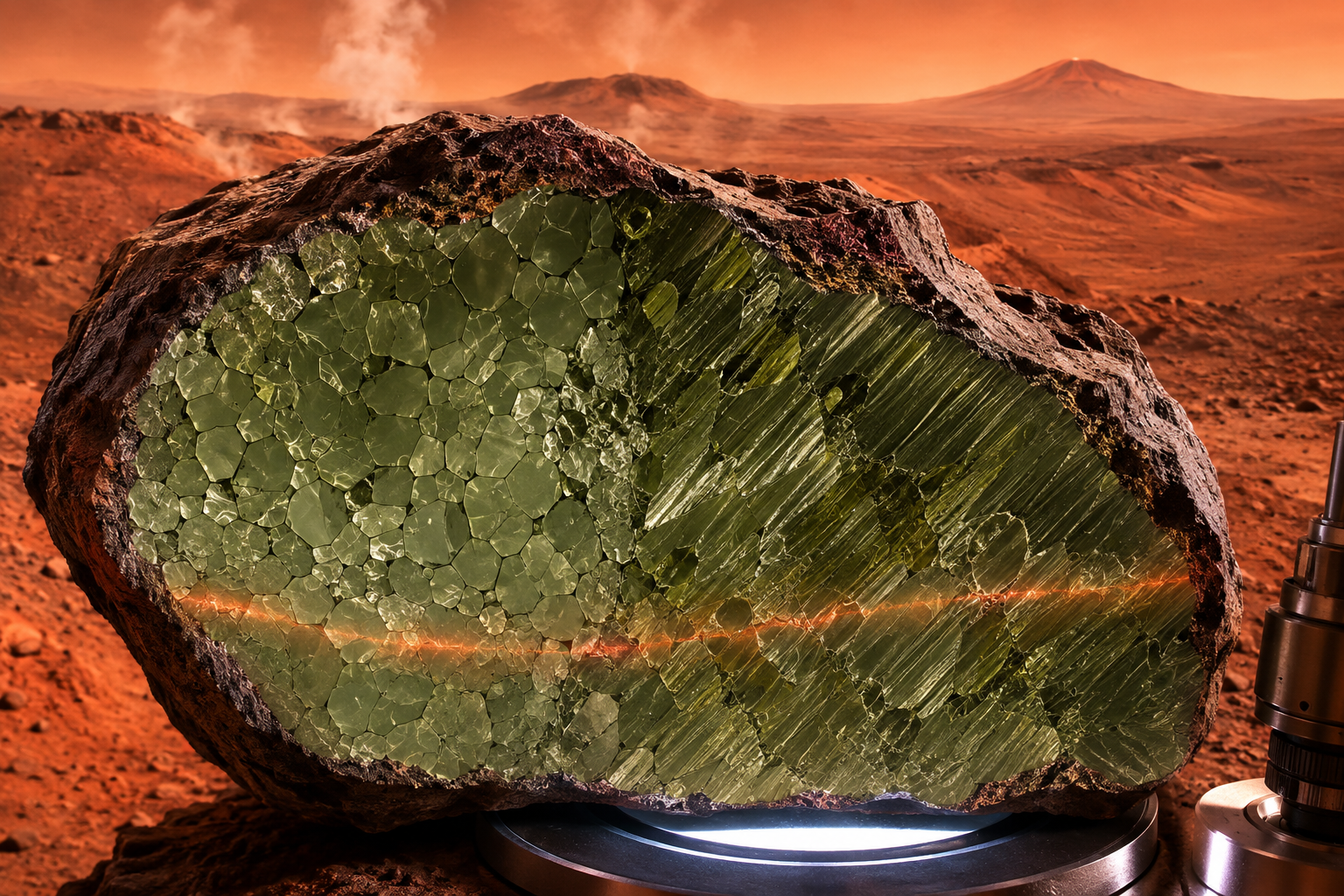
A Martian meteorite has preserved a microscopic record of deformation that may have begun inside the Martian crust hundreds of millions of years ago. Using advanced three-dimensional X-ray imaging, researchers identified two sharply different internal structures within a single olivine crystal from the Northwest Africa 7721 meteorite.
The findings suggest that the mineral was already strained while magma was moving and solidifying within Mars before a later impact event shocked, heated and partially recrystallized it. The study provides unusually detailed evidence that Martian meteorites can retain overlapping records of volcanic, tectonic and impact processes.
Two Structures Inside One Martian Crystal
NWA 7721 is a shergottite, part of the most abundant group of recognised Martian meteorites. The investigated sample contains non-poikilitic olivine, a mineral believed to have crystallised during the ascent and evolution of magma within the Martian crust.
Inside what appeared macroscopically to be a continuous olivine crystal, the researchers found two distinct populations of microscopic subgrains.
- Type 1 subgrains were generally about 3–5 micrometres across, weakly oriented and nearly free of internal strain.
- Type 2 subgrains were larger, commonly exceeding 15 micrometres, strongly aligned and marked by extensive strain and low-angle internal boundaries.
The coexistence of these structures is important because a single short-lived impact shock would not normally be expected to produce both a well-organised inherited fabric and fine, nearly strain-free recrystallised grains inside the same crystal.
Three-Dimensional X-Ray Imaging Reveals Hidden Strain
The team combined electron backscatter diffraction, two-dimensional micro-X-ray diffraction and dark-field X-ray microscopy. The dark-field technique uses diffraction from a selected crystal lattice plane to map minute orientation changes and strain fields inside a material without destroying it.
The measurements were conducted at beamline ID03 of the European Synchrotron Radiation Facility in France. By scanning successive layers through the meteorite sample, the researchers reconstructed the internal subgrain structures in three dimensions.
Type 1 grains displayed very small orientation variations and low internal misorientation, supporting the interpretation that they formed through recrystallisation. Type 2 grains showed a much broader crystallographic spread, with their measured mosaicity approximately 12 times greater than that of Type 1 grains.
The Type 2 regions also contained repeating bands of aligned dislocations and low-angle boundaries spaced roughly 10–25 micrometres apart. These features extended through multiple scanned layers, indicating that they were organised three-dimensional structures rather than isolated surface patterns.
Evidence of Deformation Before the Impact
In olivine, strongly aligned grain shapes and crystal orientations usually develop through sustained deformation rather than a brief impact pulse. The researchers therefore interpret the Type 2 structures as remnants of strain that existed before the meteorite experienced its major shock event.
According to the proposed model, the parent crystal was deformed during the late-stage ascent, degassing and emplacement of partially crystallised Martian magma. Differential stresses within this moving crystal-rich material may have generated aligned dislocations and internal boundaries.
To test whether the observed bands resembled structures produced by long-term deformation, the team compared the Martian olivine with olivine from the Åheim peridotite in Norway. The terrestrial sample records tectonic shear and showed similar periodic sub-boundary patterns, although its deformation was more uniform and substantially less intense than that found in the meteorite’s Type 2 grains.
This comparison supports the interpretation that the larger Martian subgrains preserved an inherited deformation fabric that was later modified, rather than created entirely, by impact shock.
A Shock Event Partially Recrystallised the Mineral
The researchers propose that a later impact sent a powerful shock wave through the already strained crystal. Rapid compression and unloading released stored elastic energy, encouraged dislocation movement and reorganised parts of the mineral’s internal structure.
Regions containing higher stored strain energy underwent shock-assisted recrystallisation, producing the fine and comparatively strain-free Type 1 grains. Other regions retained larger strained domains, becoming the Type 2 relics observed in the study.
The meteorite contains shock-related mosaicism, staining and localised melt. These characteristics place it near the S5 stage of the conventional meteorite shock scale, representing moderate-to-strong shock conditions.
However, the absence of widespread high-pressure mineral phases suggests that the event was intense but brief. The findings are consistent with a shock striking a relatively cool target that already contained a substantial deformation fabric.
Heating May Have Lasted Only Seconds
The researchers used experimentally derived olivine grain-growth models to estimate how long the meteorite remained hot enough for recrystallisation. Their calculations indicate that cooling through the relevant temperature range may have occurred in approximately 2.3 seconds for a shock-heated region around one millimetre across.
This brief interval could have allowed small recrystallised grains to nucleate and grow while preventing complete recovery of the larger strained regions. As a result, the impact modified the crystal without erasing the older record preserved within it.
The exact thermal conditions remain model-dependent because grain growth varies with temperature, porosity, melt content, water availability and the amount of stored strain. Nevertheless, the small size of the Type 1 grains and the survival of the Type 2 deformation network are consistent with rapid heating followed by equally rapid cooling.
A Multi-Stage History Written in Olivine
The researchers describe a three-stage history for the meteorite’s internal structure. First, magma movement and emplacement generated deformation within the olivine crystal. Second, impact loading and unloading reorganised the pre-existing dislocation network and triggered local recrystallisation. Finally, rapid post-shock cooling preserved both the newly formed fine grains and the older strained domains.
The interpretation supports models in which poikilitic shergottites formed through crystallisation at different pressures as magma rose through the Martian crust. In this scenario, their non-poikilitic olivine formed during later stages of magma ascent, where crystals could experience differential stresses and preserve internal strain.
The researchers associate this deformation history with relatively young Martian geological activity, potentially within the broad period of approximately 130–600 million years ago. This timing is based on the known geological ages and proposed source history of shergottite meteorites rather than a direct age measurement of the individual deformation structures.
A New Tool for Reading Planetary Materials
The work represents the first reported application of dark-field X-ray microscopy to a highly shocked geological material of this kind. Unlike conventional surface-based techniques, the method allowed researchers to follow crystallographic boundaries and strain patterns through the depth of the mineral.
Combining three-dimensional X-ray microscopy with electron and diffraction measurements may help scientists separate impact-generated features from older structures in meteorites, lunar samples and returned planetary materials.
NWA 7721 therefore records more than the impact that launched Martian material into space. Its olivine appears to preserve an earlier chapter of magma movement and crustal deformation, followed by a shock event that altered the mineral without completely erasing its previous history.