

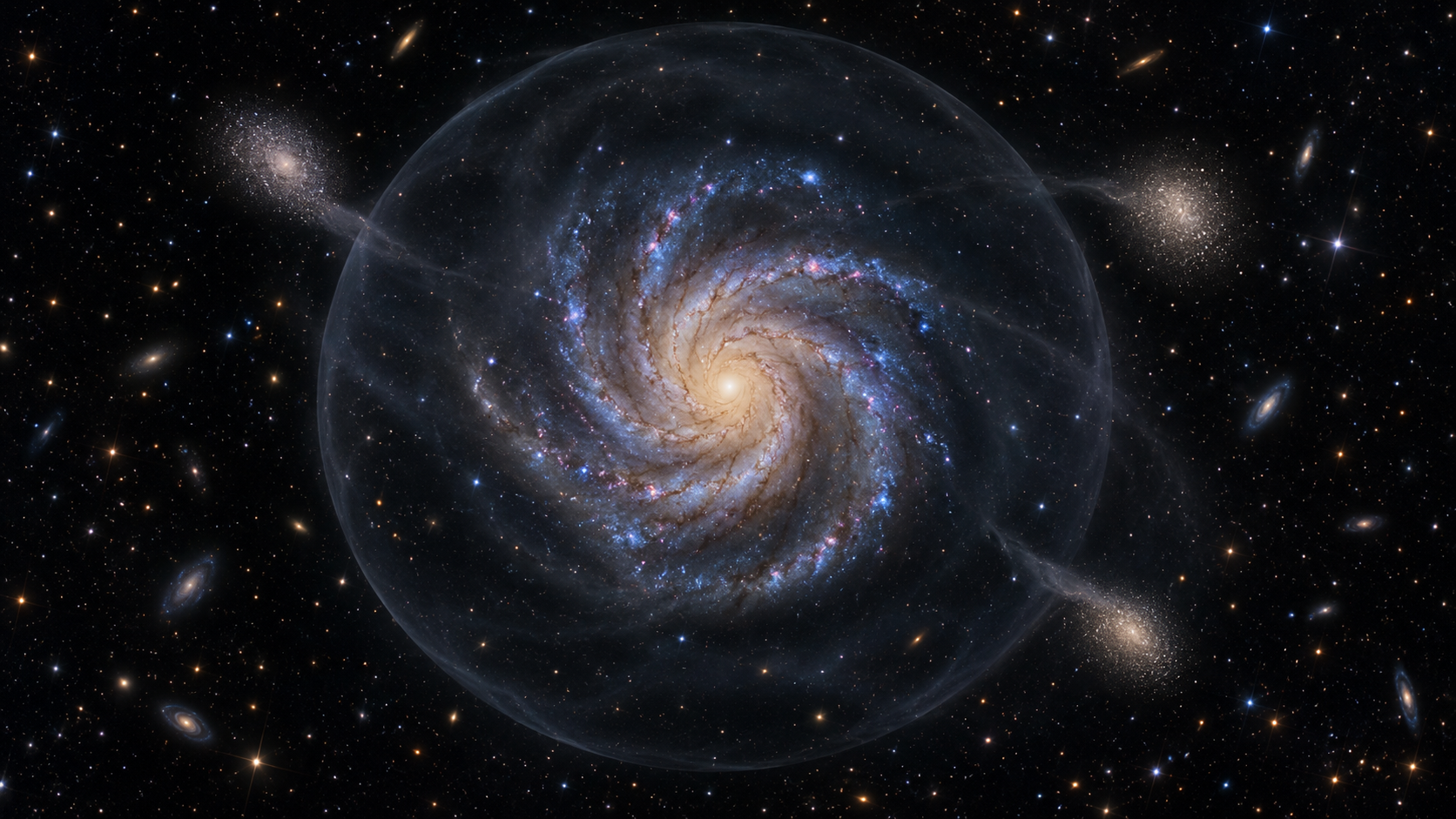
Three extremely faint dwarf galaxy candidates found beyond the estimated outer boundary of the nearby spiral galaxy M101 may be examples of a population that astronomers have long predicted but have struggled to identify observationally: backsplash galaxies.
The objects, named Shapiro DG-I/MAGE1412+5650, Shapiro DG-II and Shapiro DG-III, are described in a study published in The Astrophysical Journal. All three appear to be quiescent dwarf galaxies, meaning that observations show no evidence for significant recent star formation. Their positions and provisional distances make them possible former satellites of M101 that may once have travelled through its halo before moving outward again.
The interpretation remains tentative. The available distance measurements are not yet precise enough to reconstruct the galaxies’ relationship with M101, and the researchers identify other possible explanations, including cosmic web stripping. Shapiro DG-II could also be a faint satellite of the nearby galaxy NGC 5585.
Three Faint Galaxies Beyond M101’s Virial Radius
M101, also known as the Pinwheel Galaxy, is a nearby spiral galaxy at a distance of about 6.7 million parsecs, or roughly 22 million light-years. Its estimated virial radius is about 250 kiloparsecs, defining the approximate region in which its dark matter halo gravitationally dominates its satellite system.
The three candidate dwarfs lie outside that radius in projection. Shapiro DG-I/MAGE1412+5650 is about 329 kiloparsecs from M101 in projected separation, Shapiro DG-II about 324 kiloparsecs and Shapiro DG-III about 289 kiloparsecs.
Shapiro DG-I and DG-II were identified in archival observations from Subaru Telescope’s Hyper Suprime-Cam, while DG-III was found using the Hyper Suprime-Cam Legacy Archive. Shapiro DG-I was independently discovered at about the same time through the ID-MAGE survey and is also catalogued as MAGE1412+5650.
The Subaru images partially resolve the galaxies into individual stars. Their overall appearance resembles dwarf spheroidal galaxies: small, diffuse systems dominated by older stars and showing little or no current star formation.
What Is a Backsplash Galaxy?
A galaxy located outside a larger galaxy’s virial radius has not necessarily remained isolated throughout its history. Simulations predict that some small galaxies can fall deep into a massive host’s halo, pass through the dense surrounding environment and later travel outward beyond the virial boundary again.
These systems are known as backsplash galaxies. During their earlier passage near the host, environmental processes such as ram-pressure stripping can remove gas that would otherwise fuel new stars. The dwarf can therefore emerge from the host halo with greatly reduced gas supplies and remain quenched even after moving into a region where most comparable isolated dwarf galaxies are still forming stars.
This makes a faint, gas-poor dwarf well beyond a major galaxy’s virial radius scientifically interesting. Its present location may look isolated even though its stellar and gas properties preserve evidence of a much more environmentally active past.
Provisional Distances Place the Candidates Near M101
Determining whether the three galaxies are truly associated with M101 requires reliable distances. The study used surface-brightness fluctuations, or SBF, to make initial estimates from archival Canada–France–Hawaii Telescope Legacy Survey and Hyper Suprime-Cam images.
SBF measurements exploit small variations in a galaxy’s unresolved stellar light. Nearby stellar populations produce different pixel-to-pixel brightness fluctuations from otherwise similar populations located farther away, allowing astronomers to estimate distance when the stellar population can be adequately modelled.
The resulting estimates place Shapiro DG-I at roughly 4.2 megaparsecs, DG-II at about 6.2 megaparsecs and DG-III at approximately 8.0 megaparsecs. Because the uncertainties are substantial, the researchers describe these distances as provisional rather than definitive.
The galaxies’ partially resolved stars also help rule out much closer membership in the Local Group, while the depth of the Subaru data provides an approximate upper-distance limit of about 16 megaparsecs.
Small and Extremely Faint Dwarf Galaxies
Using the provisional distances, the researchers estimate half-light radii of roughly 110 to 140 parsecs for the three systems. Their absolute V-band magnitudes fall between approximately −7.3 and −8.1, placing them among very faint dwarf galaxies.
Their fitted Sérsic indices range from about 0.4 to 0.5, while their ellipticities are approximately 0.2 to 0.3. These structural properties, together with their dwarf-spheroidal appearance, are broadly consistent with other known quenched dwarf galaxies in the nearby Universe.
However, properties such as physical size and absolute luminosity depend on distance. More accurate measurements could therefore modify several of these derived quantities.
Multiple Observations Point to Little Recent Star Formation
A central part of the backsplash interpretation is the apparent absence of recent star formation.
The researchers examined ultraviolet observations from NASA’s Galaxy Evolution Explorer, or GALEX. None of the three galaxies was detected in either the relevant near-ultraviolet or far-ultraviolet data. Ultraviolet emission is an important tracer of young stellar populations, so these nondetections place strong upper limits on recent star formation.
Follow-up observations of Shapiro DG-I/MAGE1412+5650 using the Two-Meter Twin Telescope facility also produced no detection in hydrogen-alpha emission, another commonly used indicator of active star formation.
Radio observations from the Apertif survey were additionally examined for neutral atomic hydrogen. No coincident resolved source was detected for Shapiro DG-I or DG-II, the two candidates covered by the survey. The study derives three-sigma upper limits of about 1.4 × 10⁵ solar masses of neutral hydrogen for DG-I and 3.0 × 10⁵ solar masses for DG-II.
Taken together, the ultraviolet, hydrogen-alpha and radio constraints support the conclusion that these systems are quiescent and comparatively gas-poor.
Backsplash Is Not the Only Explanation
The observations do not yet establish that any of the three galaxies passed through M101’s halo.
One alternative is cosmic web stripping. A low-mass galaxy travelling through sufficiently dense material in the cosmic web can potentially lose gas even without becoming a conventional satellite of a large galaxy. That process can also produce isolated, quenched dwarf systems.
Shapiro DG-II has an additional complication because its projected position falls within the estimated virial radius of NGC 5585. It could therefore be an unusually faint satellite of that galaxy rather than a backsplash system associated with M101. Shapiro DG-I is also near NGC 5585 in projection but lies outside its estimated virial radius.
The current distance uncertainties prevent the researchers from distinguishing these scenarios with high confidence.
Hubble and JWST Could Test the Backsplash Scenario
Deeper observations with the Hubble Space Telescope or James Webb Space Telescope could provide much stronger distance measurements by resolving enough stars to locate the tip of the red giant branch. This established distance indicator would considerably narrow the candidates’ possible three-dimensional positions relative to M101 and NGC 5585.
Ground-based spectroscopy could provide radial velocities, adding another important piece of information about how the galaxies are moving. Together, accurate distances and velocities would help determine whether their present locations and motions are consistent with having previously passed through M101’s halo.
Future Surveys Could Find Many More Candidates
The study also considers how dwarf-galaxy populations can be used to test models of structure formation under the Lambda cold dark matter framework. The expected number of satellites depends partly on a host galaxy’s dark matter halo mass and environment, and similar modelling could eventually be extended to backsplash populations.
Wide and deep optical surveys from the Vera C. Rubin Observatory are expected to greatly expand searches for faint dwarf galaxies around nearby systems. A larger sample would allow astronomers to move beyond individual candidates and compare the abundance and distribution of backsplash galaxies with predictions from cosmological simulations.
For now, Shapiro DG-I/MAGE1412+5650, Shapiro DG-II and Shapiro DG-III remain candidates rather than confirmed backsplash galaxies. Their faintness, apparent quiescence and locations beyond M101’s estimated virial radius make them promising targets, but resolving their histories will depend on substantially more precise distance measurements and follow-up observations.