

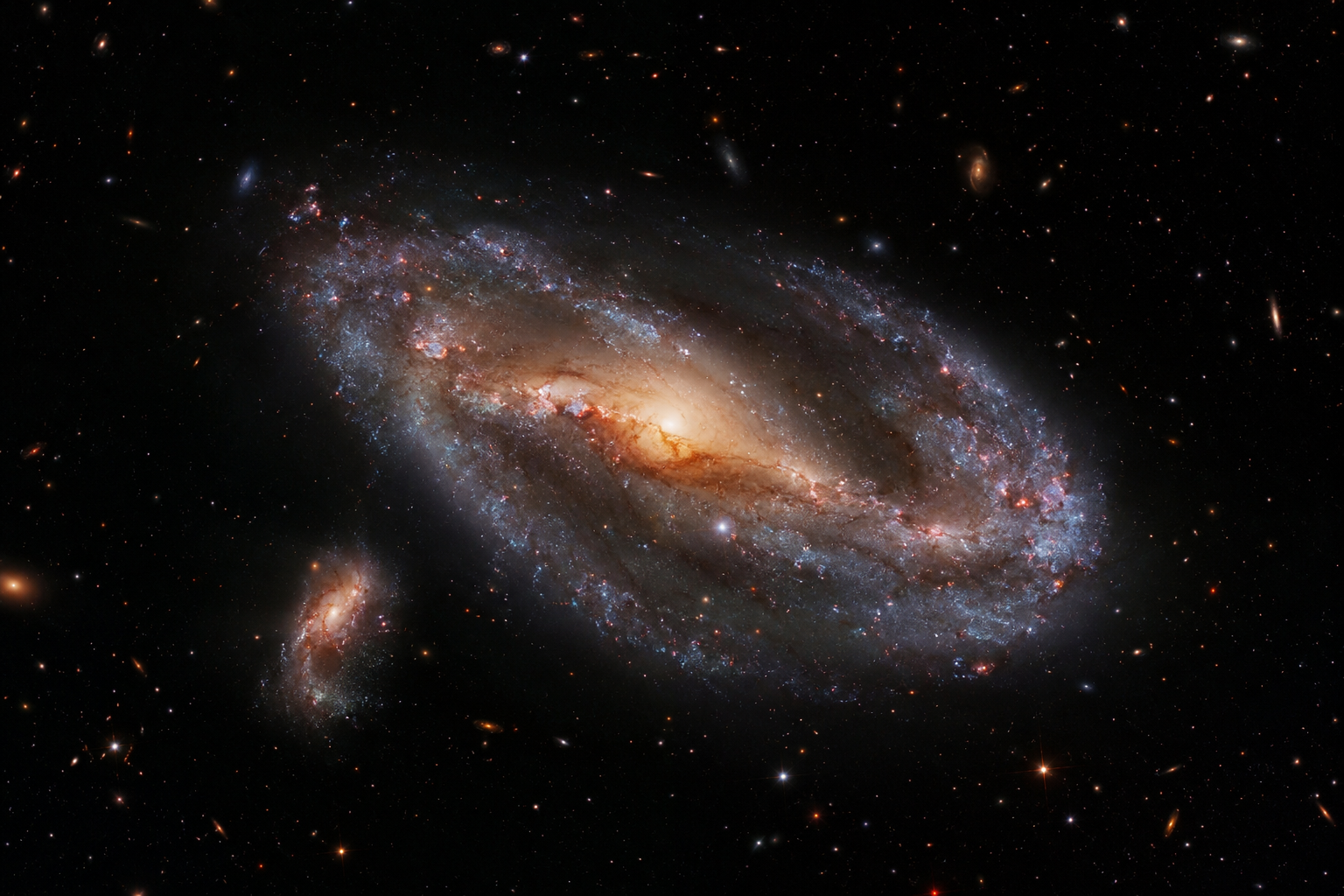
Astronomers using the James Webb Space Telescope and Hubble Space Telescope have identified a candidate for the earliest known barred spiral galaxy, pushing mature galactic structure back to a time when the universe was only about 1.1 billion years old.
The galaxy, named M1149-BSG-z5, lies at a spectroscopic redshift of z = 5.102. According to the study, it shows evidence for a stellar bar about 4.5 kiloparsecs long, extended spiral-arm structure, a concentrated central bulge, active star formation, and an active galactic nucleus.
A Mature Galaxy in the Early Universe
Barred spiral galaxies are common in the nearby universe, including the Milky Way. Their central bars are elongated structures made of stars, and they can influence how gas moves through a galaxy. These bars can help drive gas inward, support central star formation, and affect the long-term evolution of a galaxy.
Finding such a structure at redshift 5.102 is important because early galaxies are usually expected to be more turbulent, gas-rich, and dynamically unsettled. In that environment, stable bars and ordered disk structures were not expected to be common so early in cosmic history.
What JWST Observed
The researchers identified M1149-BSG-z5 in the parallel field of the galaxy cluster MACS J1149+2223. The analysis used JWST near-infrared imaging, HST optical imaging, and JWST NIRSpec spectroscopy.
The galaxy was observed across multiple wavelength bands from 0.4 to 5.0 microns. In the longer-wavelength JWST images, which trace older stellar light more clearly, the team found a smooth elongated structure consistent with a stellar bar rather than a random group of clumps.
The team used ellipse isophote fitting and structural modelling to test the bar interpretation. Both methods supported the presence of a bar-like structure. The optical-wavelength measurement gave a bar length of about 4.50 kiloparsecs, while residual modelling also revealed spiral-like structures extending from the galaxy.
A Massive Star-Forming System
M1149-BSG-z5 is not a small primitive galaxy. The study estimates a stellar mass of about 1010.45 solar masses and a star-formation rate of about 144 solar masses per year. This places it on the star-forming main sequence for galaxies at roughly the same redshift.
The galaxy also appears larger than typical galaxies observed at similar redshifts. Its effective radius is measured at 2.61 kiloparsecs, making it comparable in size to barred galaxies seen at lower redshifts between z = 2 and z = 4.
Evidence for an Active Galactic Nucleus
JWST NIRSpec observations detected several emission lines, including Hβ, [O III], Hα, [N II], and [S II]. The Hα line includes a broad component, which the researchers interpret as evidence for a broad-line active galactic nucleus.
The estimated black hole mass is about 107.5 solar masses. Its black-hole-to-stellar-mass ratio is around 10-3, which is lower than many high-redshift AGNs discovered by JWST and more similar to broad-line AGNs in the local universe.
A Chemically Evolved Early Galaxy
The emission-line properties also suggest that M1149-BSG-z5 was already chemically enriched. The study estimates an oxygen abundance of about half the solar value, although the authors caution that AGN ionization can complicate metallicity measurements.
Still, the galaxy’s high mass, strong star formation, central activity, and metal-enriched gas all point toward a system that had already undergone significant assembly and evolution within the first billion years of cosmic history.
How Could a Bar Form So Early?
The researchers discuss two main possibilities. One is that the bar may have been triggered by interactions. M1149-BSG-z5 appears to reside in an overdense region, and a nearby companion galaxy lies about 21.2 kiloparsecs away in projected distance with a very similar spectroscopic redshift.
The second possibility is gravitational instability in a baryon-rich, gas-rich disk. If the galaxy assembled a massive central stellar component early, internal disk instabilities may have helped form the bar faster than expected.
Why This Discovery Matters
The discovery suggests that mature disk structures may have emerged earlier than conventional models predicted. If confirmed with future kinematic observations, M1149-BSG-z5 would provide an important test case for understanding how rapidly galaxies could organize themselves after the Big Bang.
The authors note that spatially resolved velocity measurements from future JWST or ALMA observations will be needed to confirm the dynamical nature of the bar and determine whether interaction, internal instability, or both processes shaped this early barred spiral galaxy.