

Faint Red Auroras Over Japan Point to Unusual Space Weather Conditions
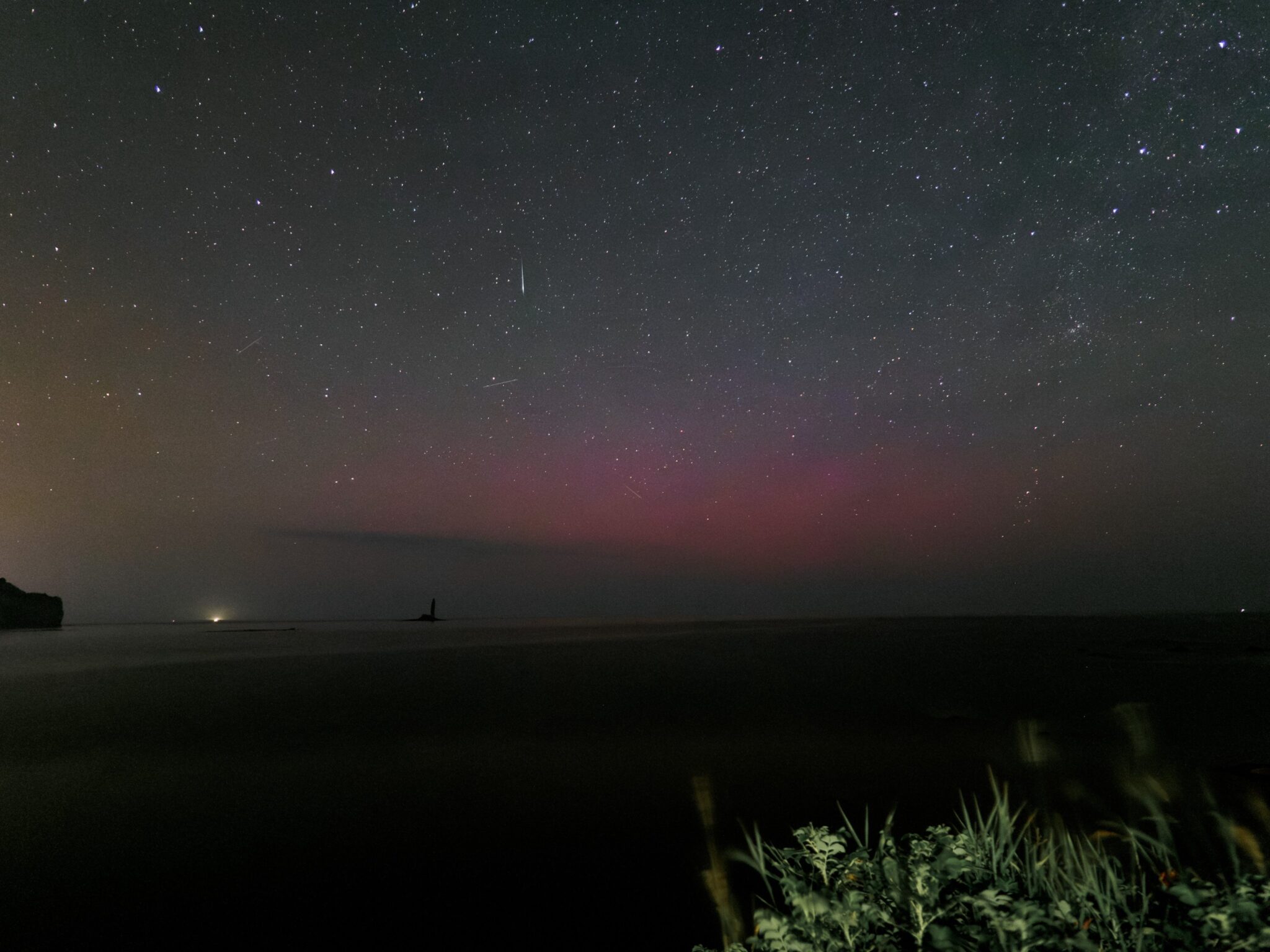
Faint red auroras observed from Japan during 2024 and 2025 may reveal more about Earth’s near-space environment than their weak visual appearance suggests. A new study reports that several low-latitude auroral events over Hokkaido occurred during magnetic storms that were not extreme by standard storm measurements, but were accompanied by strong magnetospheric compression.
The research, published in the Journal of Space Weather and Space Climate, examines four red aurora events seen from Japan on June 28, August 4, September 12, and November 9, 2024. The study also discusses a separate red aurora event on March 26, 2025, linked to a corotating interaction region, or CIR.
Why These Auroras Matter
Auroras are usually associated with high-latitude regions near the poles, where charged particles from space interact with Earth’s upper atmosphere. During magnetic storms, the auroral oval can expand toward lower latitudes, allowing auroras to be seen from places such as northern Japan.
What makes these events notable is that they occurred during magnetic storms with peak Dst values around -100 nT to -121 nT for the 2024 events. These are significant storms, but not among the most extreme. Despite that, the auroras appeared from Hokkaido and, in one case, from Akita Prefecture on Japan’s main island.
Citizen Science Played a Central Role
The study relied heavily on photographs taken by citizen scientists across Japan. Researchers used auroral images from multiple locations, along with satellite data, to estimate the height and extent of the auroral emissions.
This citizen-science network was especially important because some of the auroras were too faint to be seen clearly with the naked eye. Modern cameras, including high-sensitivity equipment used by amateur observers, helped capture faint red and magenta emissions that might otherwise have gone undocumented.
Red Auroras Reached Very High Altitudes
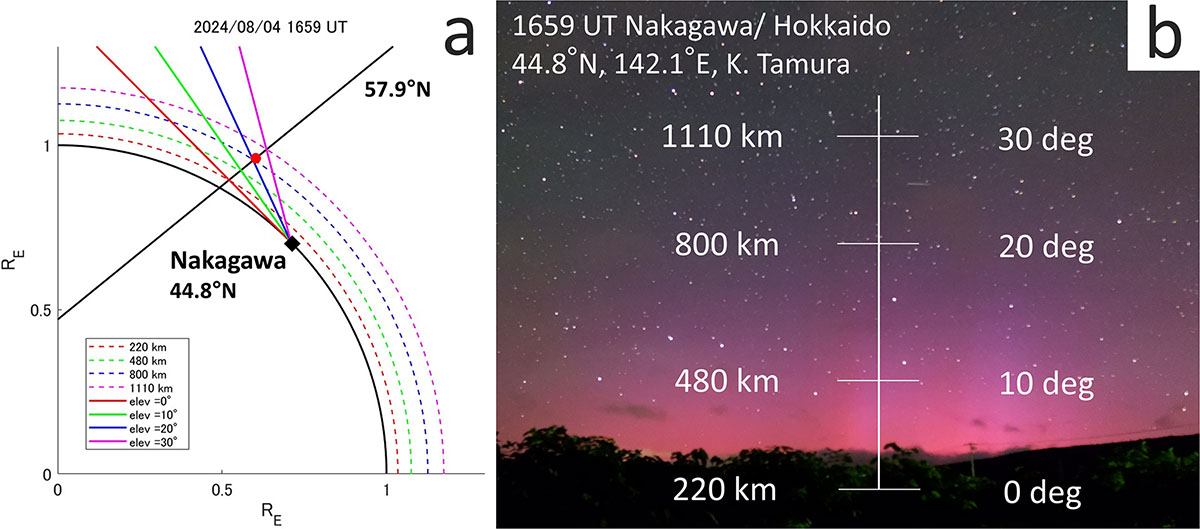
Image Credits: Tomohiro M. Nakayama and Ryuho Kataoka / Journal of Space Weather and Space Climate
The researchers estimated that the red auroras extended to unusually high altitudes, roughly between 490 km and 800 km. This is higher than typical red auroral emissions, which are often reported around 400 km to 600 km.
For example, the June 28, 2024 event was estimated to reach about 650 km, while the August 4 event may have reached around 800 km. The September 12 event was estimated at about 630 km, and the November 9 event reached roughly 490 km to 570 km. The March 26, 2025 CIR-driven event was estimated at about 550 km to 750 km.
Compressed Magnetosphere May Have Changed the Storm Picture
The study argues that standard storm indicators may have underestimated the actual development of these events. The Dst and SYM-H indices mainly reflect the symmetric ring current around Earth, but during strong magnetospheric compression, the ring current can become more asymmetric.
In all reported auroral events, the ASYM-H index increased to about 1.3 to 2.0 times the SYM-H peak amplitude. This suggests that partial ring current development was unusually important and that the storms were more geoeffective than their Dst values alone indicated.
Dense Solar Wind Appears to Be an Important Factor
The researchers found that many of the Japan aurora events were associated with dense solar wind and moderate solar wind speeds. In several cases, the solar wind density exceeded roughly 30 particles per cubic centimetre, contributing to stronger-than-usual compression of Earth’s magnetosphere.
However, the study also cautions that solar wind density alone cannot fully explain all low-latitude red auroras. Comparisons with earlier Solar Cycle 23 events show that some red auroras occurred without very high solar wind density. The relationship between solar wind density, solar wind speed, magnetospheric compression, and auroral visibility remains complex.
Possible Link to Atmospheric Heating and Satellite Drag
The high altitude of the red auroras may indicate enhanced density in the upper thermosphere. The authors suggest that Joule heating during magnetic storms could contribute to this atmospheric expansion, especially at subauroral latitudes.
This matters for satellite operations. Increased thermospheric density can raise atmospheric drag on low Earth orbit satellites, affecting their orbital altitude and lifetime. Understanding how moderate magnetic storms can still produce strong atmospheric effects is important for space weather forecasting and satellite risk management.
A Need for Better Space Weather Models
The study highlights that current understanding of these events remains incomplete. The physical mechanism connecting dense solar wind, intense magnetospheric compression, high-altitude red auroras, and thermospheric heating is not yet fully resolved.
The researchers call for more detailed modelling of moderate magnetic storms, not only major or extreme storms. They also emphasize that continued citizen-science observations can help build a larger dataset for future statistical studies of low-latitude auroras.
The faint red auroras seen from Japan in 2024 and 2025 show that visually subtle events can carry important information about Earth’s magnetosphere and upper atmosphere. The study suggests that compressed magnetospheric conditions and dense solar wind may help produce unusually extended red auroras, even when storm intensity appears moderate by conventional measures.
For space weather science, these events underline the value of combining satellite data, geomagnetic indices, and citizen observations. They also point to a practical concern: moderate storms may still produce atmospheric effects relevant to satellites in low Earth orbit.