

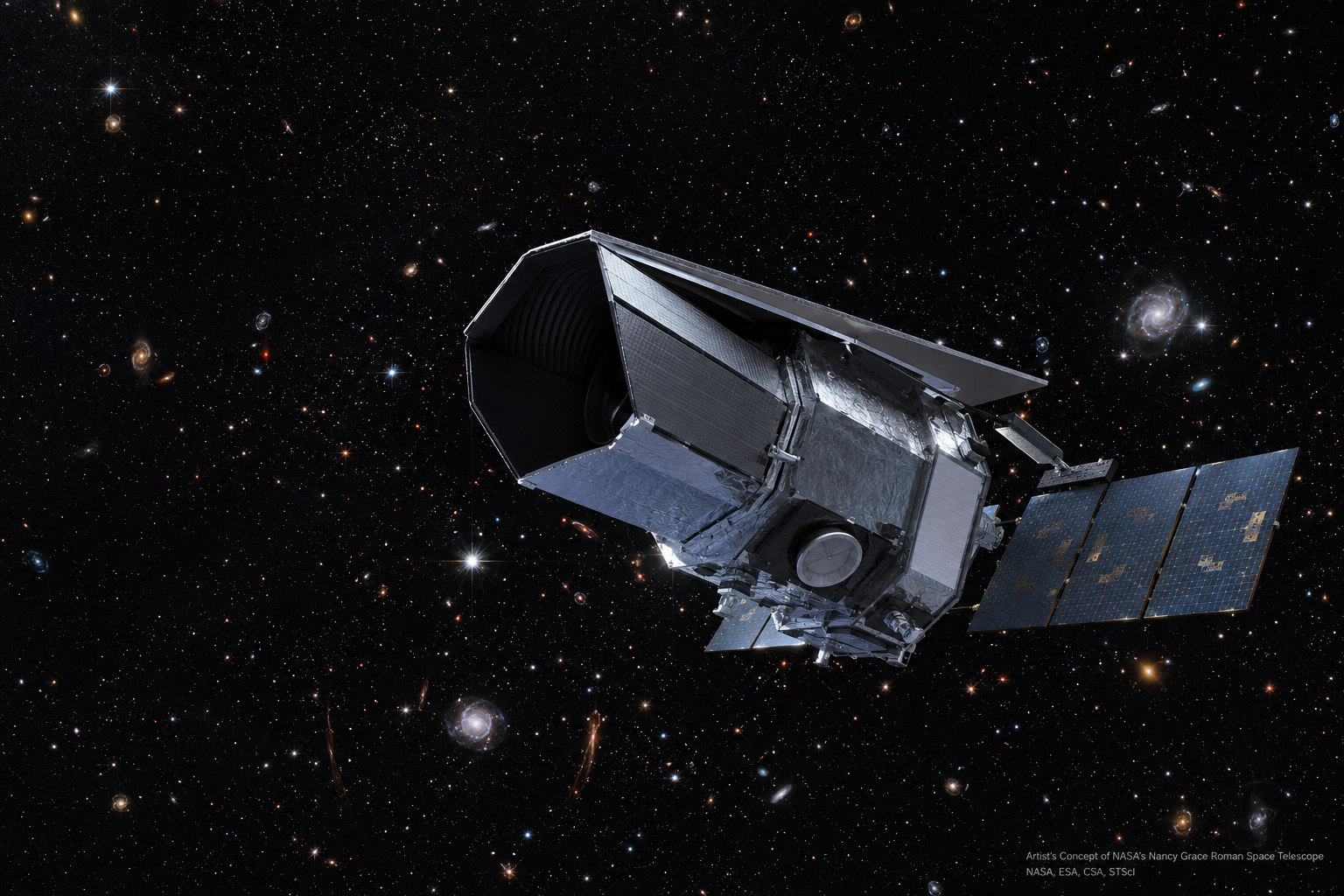
The Origins of NASA’s Roman Space Telescope
The Nancy Grace Roman Space Telescope began as an ambitious scientific concept focused on one of astronomy’s biggest mysteries: why the universe is expanding faster over time. Scientists refer to the unknown force behind this acceleration as dark energy, and understanding it became one of the highest priorities in modern astrophysics during the early 2000s.
In 2010, the U.S. National Academies’ Decadal Survey — a major roadmap for astronomy priorities — recommended the development of a powerful wide-field infrared space telescope. NASA later approved the mission, initially calling it the Wide-Field Infrared Survey Telescope, or WFIRST.
The mission underwent several design revisions over the years as engineers refined its scientific goals, instruments, and cost structure. In 2020, NASA officially renamed the observatory after Nancy Grace Roman, NASA’s first Chief of Astronomy and one of the agency’s most influential space science leaders.
Who Was Nancy Grace Roman?
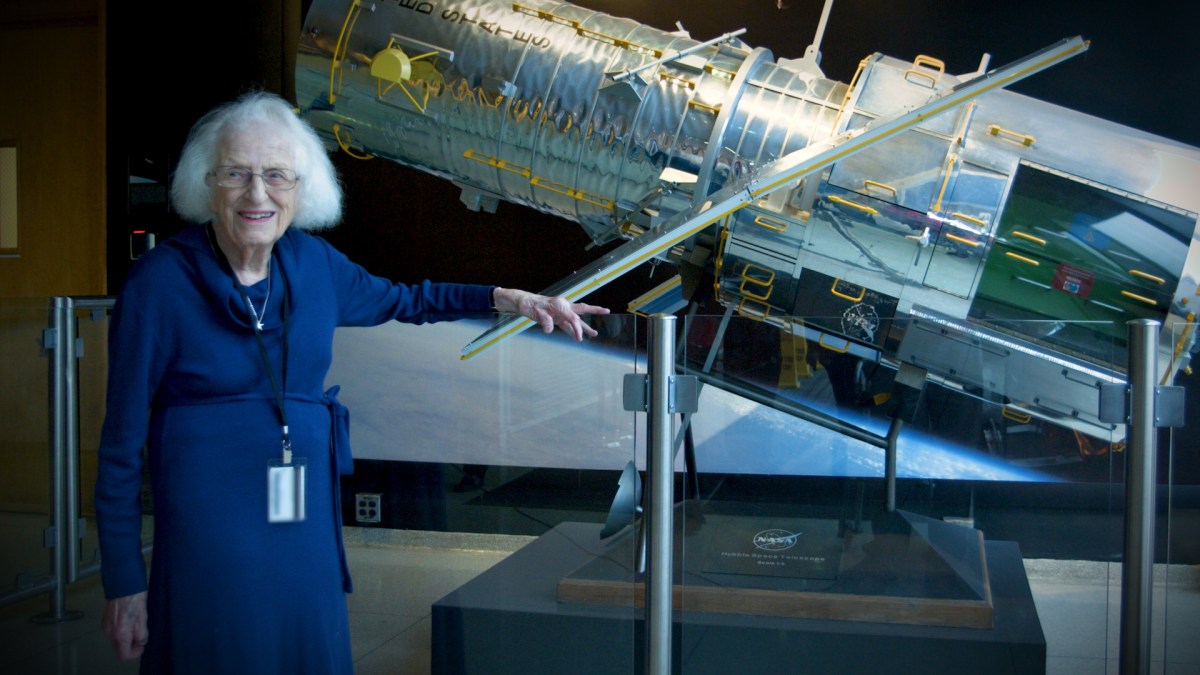
Nancy Grace Roman played a foundational role in establishing space-based astronomy inside NASA during the early years of the space age. Often referred to as the “Mother of Hubble,” she helped guide the development of major astronomical observatories and promoted the idea that telescopes placed above Earth’s atmosphere could transform humanity’s understanding of the universe.
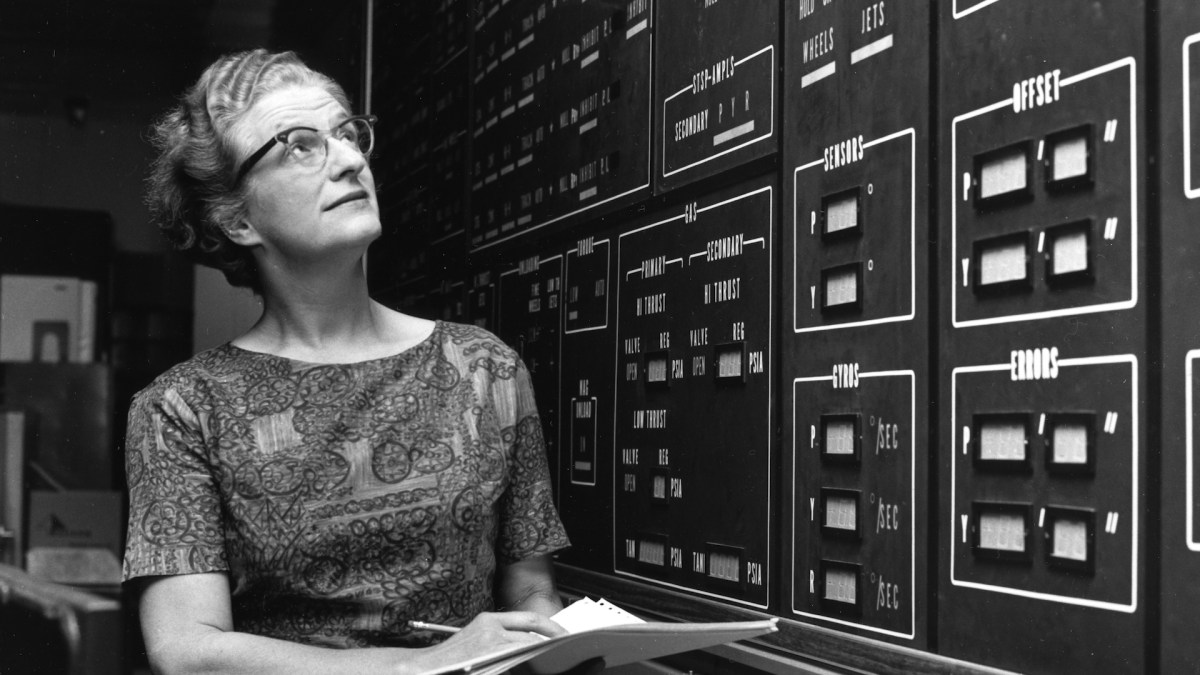
Roman worked at NASA beginning in 1959 and became the agency’s first female executive in the Office of Space Science. Her efforts helped lay the groundwork for missions such as the Hubble Space Telescope, which later revolutionized astronomy through decades of scientific discoveries.
By naming the observatory after her, NASA recognized Roman’s long-lasting contributions to astrophysics and space science leadership.
Why NASA Built the Roman Space Telescope
The Roman Space Telescope was created to answer scientific questions that current observatories cannot fully address on their own. While telescopes like Hubble and James Webb focus on detailed observations of selected objects, Roman is designed to survey enormous portions of the sky quickly and precisely.
This large-scale survey capability is essential for studying how galaxies evolved over billions of years and how dark energy influenced the structure of the universe. Scientists need massive datasets collected across huge cosmic distances to understand these processes accurately.
Roman is also expected to expand humanity’s understanding of exoplanets — planets orbiting stars beyond the Solar System. The mission will search for planets using gravitational microlensing techniques and demonstrate advanced technologies for directly imaging distant worlds.
How the Roman Space Telescope Works

The observatory uses a 2.4-meter primary mirror, similar in size to the Hubble Space Telescope’s mirror, but paired with a dramatically larger field of view. NASA says Roman can capture sky areas roughly 100 times larger than Hubble’s infrared observations in a single image while maintaining comparable resolution.
This capability comes primarily from Roman’s Wide Field Instrument, an advanced infrared imaging system designed for massive sky surveys. The instrument includes 18 highly sensitive detectors that together generate extremely detailed wide-area observations.

Roman also carries a Coronagraph Instrument, a technology demonstration system intended to block light from stars so nearby planets and dust disks become visible. Although not the mission’s primary science instrument, the coronagraph is considered an important step toward future telescopes that may directly image Earth-like planets around Sun-like stars.
The Science Goals Behind the Mission
Understanding Dark Energy
One of Roman’s most important objectives is to investigate dark energy. Scientists believe dark energy makes up most of the universe’s total energy content, yet its true nature remains unknown.
Roman will study dark energy using multiple techniques, including supernova observations, galaxy clustering measurements, and weak gravitational lensing. Together, these methods may help researchers determine whether dark energy behaves consistently over time or changes as the universe evolves.
Mapping Billions of Cosmic Objects
The telescope is expected to observe hundreds of millions of galaxies and billions of stars during its mission. These observations will allow astronomers to build detailed maps of cosmic structure across enormous distances.
Roman’s surveys may also identify rare astronomical events, including black hole interactions, stellar explosions, and gravitational lensing systems that are difficult to detect using smaller sky surveys.
Searching for Exoplanets
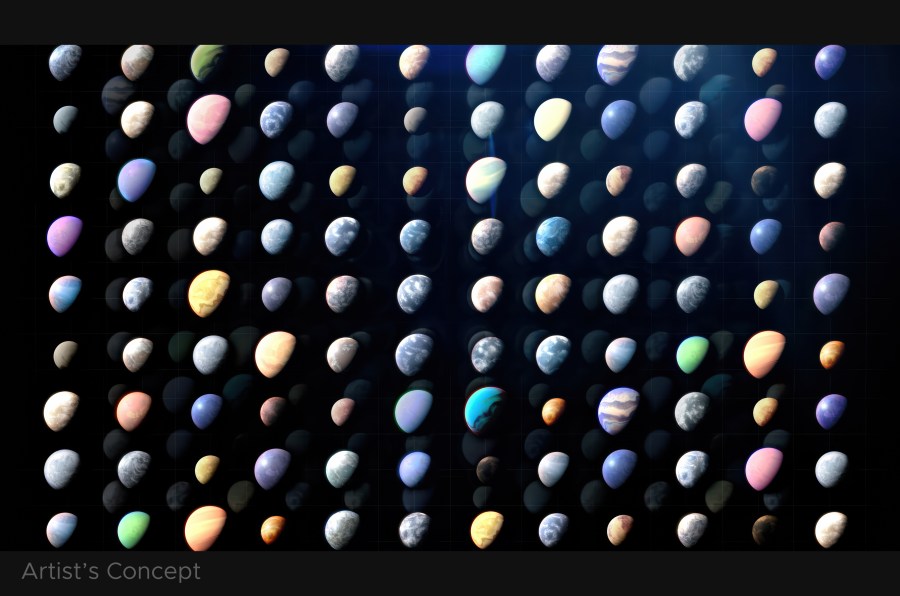
Roman will use gravitational microlensing to detect planets located far from their stars, including free-floating planets that drift through interstellar space without orbiting a host star. This technique allows astronomers to detect planetary systems that are often invisible to other planet-hunting methods.
The mission could significantly improve estimates of how common planetary systems are throughout the Milky Way galaxy.
How Roman Differs From Hubble and Webb
Although comparisons are often made between Roman, Hubble, and the James Webb Space Telescope, the three observatories are designed for different scientific purposes.
Hubble specializes in high-resolution observations across visible and ultraviolet wavelengths. Webb focuses on highly detailed infrared studies of distant galaxies, exoplanet atmospheres, and the early universe. Roman, by contrast, is optimized for large-area infrared surveys.
NASA often describes the relationship by comparing Hubble and Webb to high-powered zoom lenses, while Roman functions more like a panoramic wide-angle camera capable of scanning huge portions of the sky efficiently.
Building and Preparing the Observatory
The Roman mission involves contributions from NASA centers, aerospace contractors, research institutions, and international partners. NASA’s Goddard Space Flight Center manages the project and oversees spacecraft integration and testing activities.
Engineers spent years assembling the telescope’s optical systems, detectors, thermal shielding, communications hardware, and spacecraft bus. The observatory has undergone environmental testing to ensure it can survive launch vibrations, vacuum conditions, and temperature extremes encountered in space.
NASA announced that the mission is targeting as soon as early September 2026 for launch aboard a SpaceX Falcon Heavy rocket from Kennedy Space Center in Florida.
What Happens After Launch
After launch, Roman will travel to a gravitationally stable region known as Sun-Earth Lagrange Point 2, or L2, located roughly 1.5 million kilometers from Earth. This region is also home to the James Webb Space Telescope.
From L2, Roman will have a stable thermal environment and an uninterrupted view of deep space, allowing the observatory to conduct long-duration surveys efficiently.
Once operational, the mission is expected to generate enormous quantities of scientific data for astronomers worldwide. Many researchers believe Roman could become one of the most influential astronomical survey missions ever launched.
A Telescope Designed for the Next Era of Astronomy
The Roman Space Telescope represents a transition toward data-rich space astronomy, where scientists can study the universe not only in detail, but also at enormous scale. By combining infrared sensitivity with massive sky coverage, Roman is expected to reveal new information about dark energy, galaxy evolution, black holes, and planetary systems.
As the mission approaches launch, astronomers see Roman as a major step toward answering some of the deepest scientific questions about the structure, history, and future of the universe.