

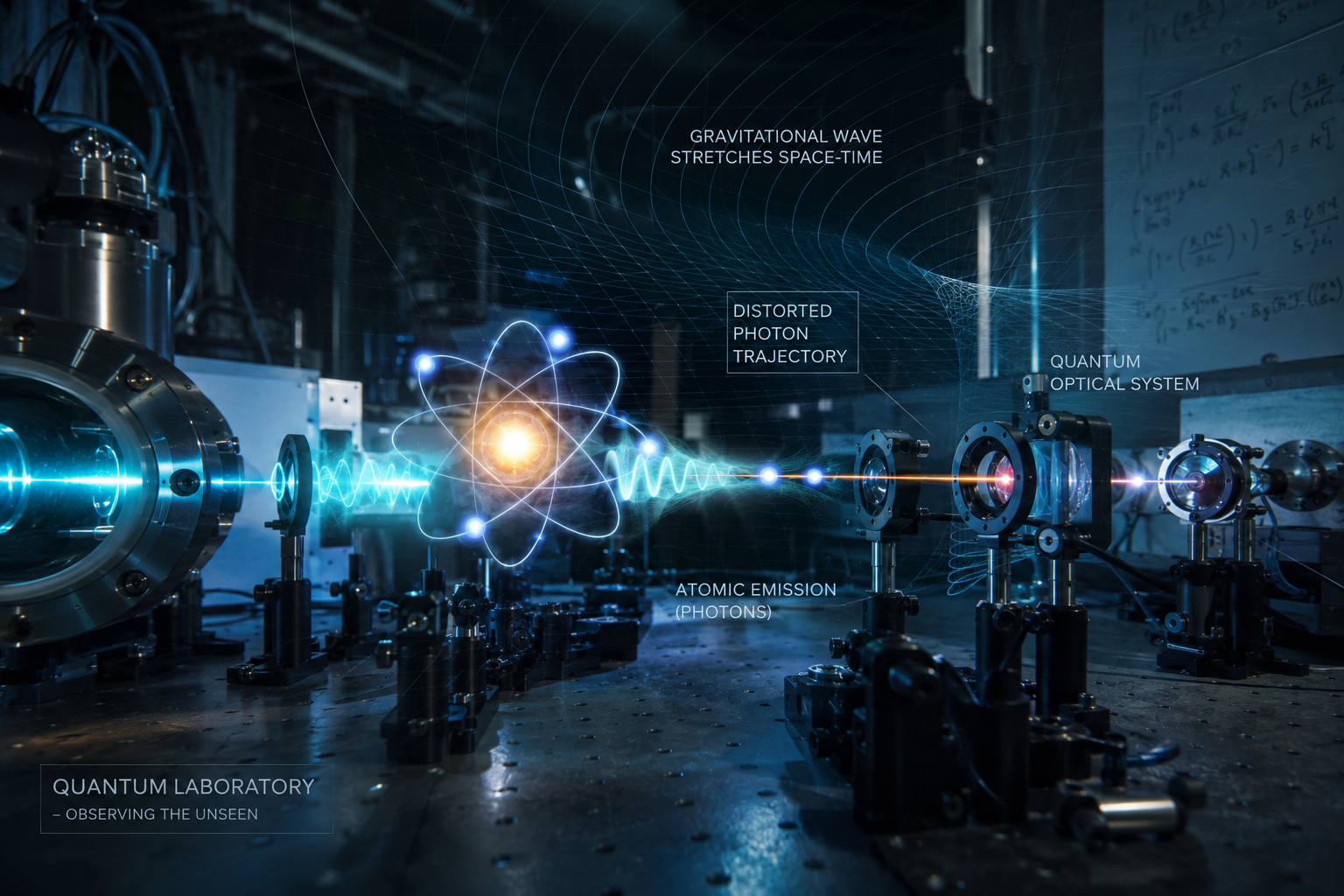
A new theoretical study suggests that gravitational waves may subtly modify how atoms emit light, offering a possible new way to study gravity through quantum systems. The research examines spontaneous emission, the process in which an excited atom naturally releases a photon and returns to a lower energy state.
The study found that a gravitational wave can create direction-dependent changes in the emitted photon spectrum. However, the total decay rate of the atom remains unchanged, meaning the gravitational wave does not leave detectable information in the atom’s internal state alone.
A Quantum Field Imprint of Spacetime
The researchers modeled a pointlike two-level atom interacting with a quantum field in a curved spacetime background. In their analysis, a plane gravitational wave periodically modulates the quantum field that interacts with the atom.
This modulation changes the spectral and directional properties of emitted photons. At higher gravitational-wave frequencies, the effect appears as sidebands in the emission spectrum. At lower frequencies, it appears as a direction-dependent frequency shift.
Directional Pattern Could Help Identify the Signal
The predicted effect has a characteristic quadrupolar pattern in the plane perpendicular to the gravitational wave’s propagation. This directional structure may help separate the signal from other effects that can influence atomic emission spectra.
The study also found that the gravitational-wave correction disappears when integrated over the full photon momentum. This means the overall emission rate remains unchanged, while the emitted light still carries information about the gravitational wave through its spectrum and direction.
Cold-Atom Experiments May Be Relevant
To estimate measurability, the researchers analyzed classical Fisher information from photon number measurements and quantum Fisher information from the full atom-field state. Their results suggest that photon measurements can extract useful information under suitable conditions.
The paper estimates that shot-noise-limited experiments may require around 10^6 to 10^8 atoms to reach sensitivity relevant to low-frequency gravitational waves in the submillihertz range. The authors note that such atom numbers have already been achieved in cold atomic cloud experiments.
A New Route for Probing Gravity
The work is theoretical and would require further study of realistic experimental noise, environmental disturbances, readout limitations, and trap-specific effects before any practical detector design can be assessed.
Still, the study presents a clear framework for exploring how gravitational waves can affect atom-light interactions. If experimentally confirmed, the effect could open a new path for probing spacetime dynamics through quantum optical systems.