
A newly published astrodynamics study proposes a lower-cost method for transferring spacecraft between Earth and the Moon using the Earth–Moon L1 Lagrangian point as an intermediary staging region. The research focuses on optimizing lunar transfers through mathematical trajectory design techniques that exploit the natural gravitational dynamics of the Earth–Moon system.
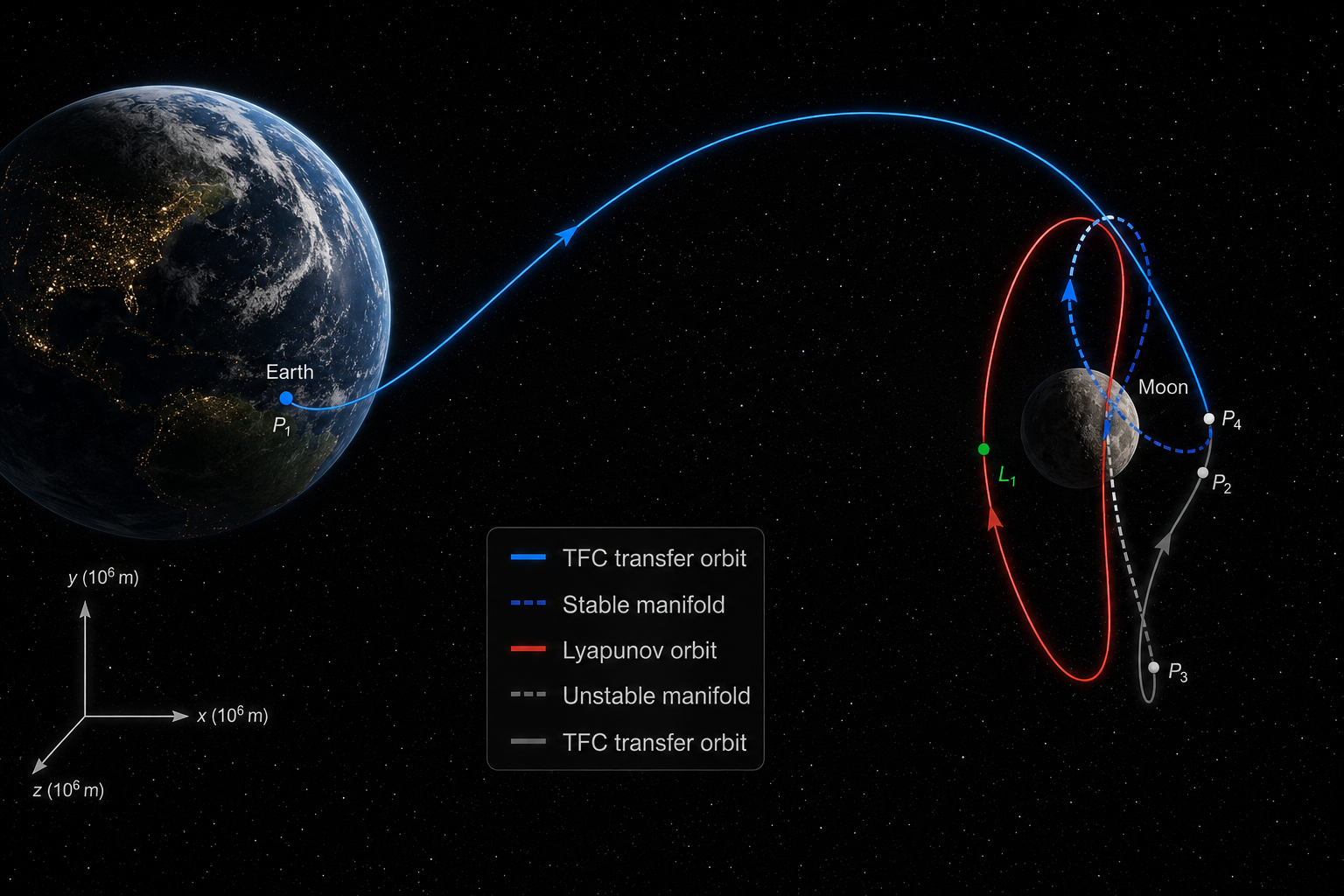
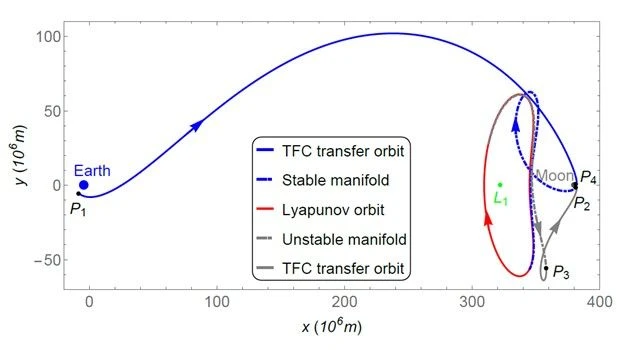
The study was conducted by researchers from institutions in Portugal and Brazil and presents a transfer architecture based on the Theory of Functional Connections (TFC) combined with invariant manifold dynamics around Lyapunov orbits near the Earth–Moon L1 point.
The findings are considered relevant for future lunar exploration missions, including cargo transport, communications infrastructure, robotic exploration, and potential long-duration cislunar operations.
Why the L1 Lagrangian Point Matters
The Earth–Moon L1 Lagrangian point is a gravitational equilibrium region located between Earth and the Moon. Spacecraft positioned near this point can take advantage of unique orbital dynamics that require relatively small propulsion corrections.
According to the paper, the L1 region could become an important transit hub for future lunar exploration efforts. Planned missions such as NASA’s Gateway station and proposed international lunar infrastructure concepts may benefit from low-energy transfer pathways through this region.
The study explains that unstable and stable invariant manifolds connected to Lyapunov orbits around L1 can naturally guide spacecraft through cislunar space with reduced propulsion demands.
Using Natural Gravitational Pathways
The researchers modeled spacecraft motion using the Circular Restricted Three-Body Problem (CRTBP), a classical framework in orbital mechanics that describes the gravitational interaction between Earth, the Moon, and a comparatively small spacecraft.
Under this framework, the team designed transfers in two main stages:
- Transfer from Earth orbit to a stable manifold connected to an L1 Lyapunov orbit
- Transfer from the unstable manifold near L1 to lunar orbit
The transfer strategy allows the spacecraft to use the natural gravitational flow of the system instead of relying entirely on large propulsion burns.
The paper describes how a Moon flyby is used before insertion into the L1-associated orbital region, followed later by transfer toward lunar orbit.
Theory of Functional Connections Applied to Spaceflight
A major component of the study is the application of the Theory of Functional Connections, or TFC. The mathematical framework allows mission constraints to be analytically embedded directly into trajectory equations.
Instead of repeatedly adjusting orbital parameters through conventional optimization alone, the method transforms the transfer problem into a constrained mathematical formulation.
The researchers state that this significantly improved computational efficiency, enabling them to evaluate tens of millions of possible trajectories.
The paper notes that previous studies often evaluated hundreds of thousands of trajectories, while the new approach scaled into multi-million solution searches.
Fuel Savings Compared to Previous Studies
The study reports that the optimized transfer from Earth orbit to the L1 Lyapunov orbit required approximately 3342.96 m/s of delta-v.
The complete Earth-to-Moon transfer architecture through the L1 region required approximately 3991.60 m/s of total delta-v.
According to the researchers, this represents a reduction of at least 58.80 m/s compared to similar transfer strategies available in previous literature.
While the numerical savings may appear modest, even small reductions in delta-v can translate into meaningful increases in payload mass, mission flexibility, or fuel reserves for deep-space missions.
Transfer Duration and Mission Flexibility
The proposed transfer architecture requires roughly 31.88 days for the complete Earth-to-Moon journey through the L1 orbital region.
The researchers note that spacecraft could remain near the Lyapunov orbit for extended periods before continuing toward lunar orbit. This flexibility could support:
- Cislunar cargo staging
- Observation missions
- Communication relay systems
- Lunar infrastructure support
- Long-duration orbital operations near L1
The study also suggests that the TFC-based trajectory design framework could later be extended to higher-fidelity models incorporating additional gravitational perturbations such as the Sun.
Potential Applications for Future Lunar Missions
As lunar activity accelerates globally, low-energy transfer methods are becoming increasingly important for reducing launch costs and improving mission efficiency.
The paper highlights possible applications involving future multinational lunar programs, robotic cargo missions, and long-term lunar support infrastructure.
The researchers conclude that the mathematical framework demonstrated in the study may also be adapted for transfers involving other Lagrangian regions, including Earth–Moon L2 missions.
The work reflects growing interest in leveraging natural orbital mechanics and advanced optimization methods to support the next generation of cislunar transportation systems.