

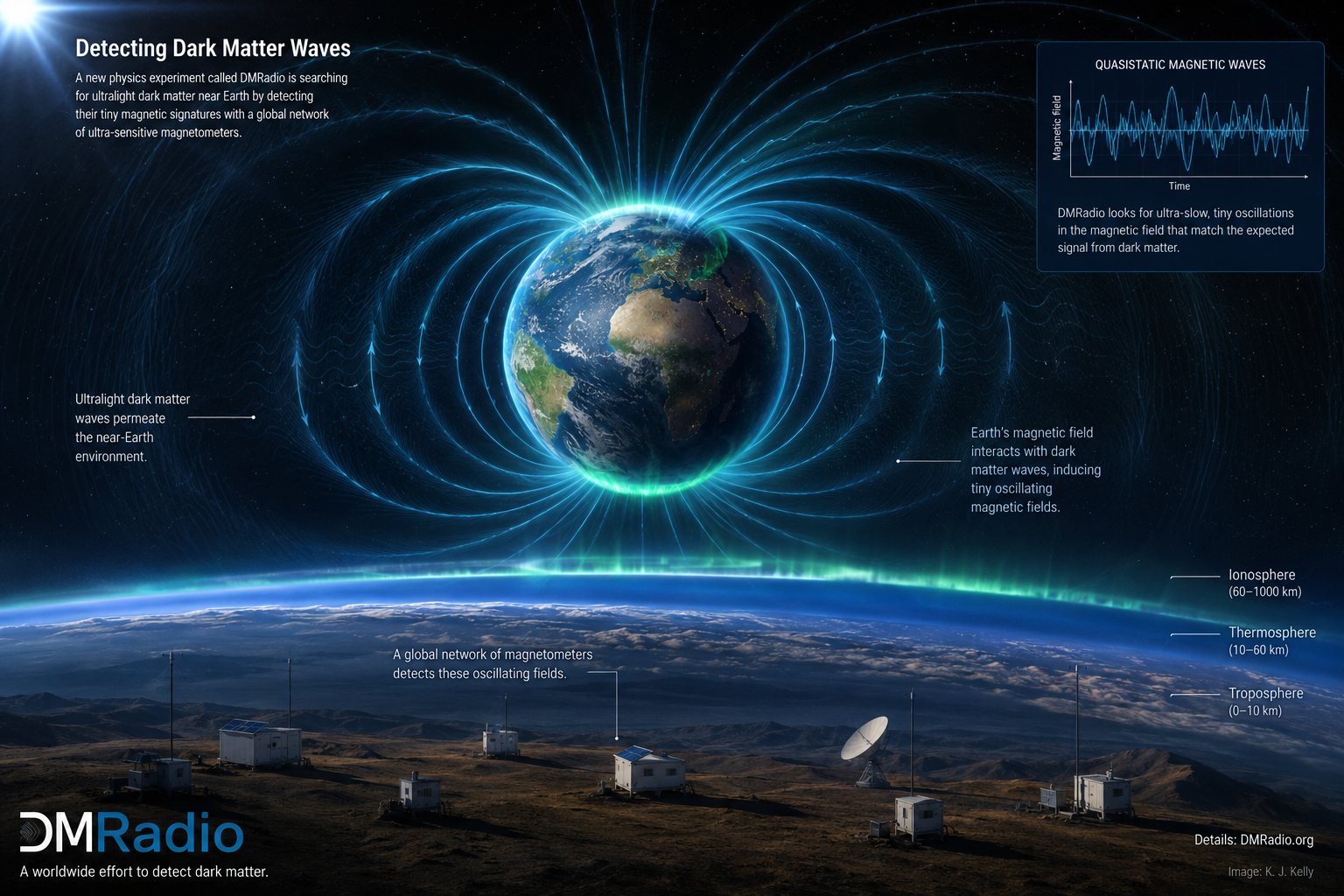
Dark matter remains one of the biggest unresolved mysteries in modern physics. Although it is believed to make up most of the matter in the universe, scientists still do not know what it is composed of. A new study now suggests that Earth itself may help detect one possible candidate known as millicharged dark matter.
The research, published in Physical Review Letters, explores how ultralight dark matter particles carrying extremely tiny electric charges could interact with Earth’s geomagnetic field and produce detectable magnetic signals.
What Is Millicharged Dark Matter?
Millicharged particles are hypothetical particles with electric charges far smaller than the electron’s charge. These particles are predicted in several extensions of the Standard Model of particle physics, including theories involving hidden sectors, kinetic mixing, grand unification, and string theory.
In the proposed scenario, ultralight bosonic dark matter behaves more like a coherent wave rather than individual particles because of its extremely low mass and high occupation number. This allows researchers to model the dark matter field using classical wave equations.
How Earth’s Magnetic Field Becomes a Detector
The researchers found that when this ultralight dark matter passes through Earth’s geomagnetic field, it can generate an oscillating effective electric current. That current then produces a weak magnetic signal detectable on the planet’s surface.
The study predicts that the signal oscillates at a frequency equal to twice the dark matter particle mass. Importantly, the magnetic signal becomes significantly stronger for lighter dark matter masses because the signal scales inversely with the square of the mass.
The team estimated the magnetic field strength using Earth-scale parameters and showed that the resulting signal could reach hundreds of picotesla for certain charge ranges.
Using Existing Magnetometer Networks
Instead of building a new experiment from scratch, the researchers analyzed existing measurements from two major geomagnetic observation projects:
- SuperMAG — a global network of magnetometers monitoring Earth’s magnetic activity.
- SNIPE Hunt — a coordinated magnetometer experiment designed to search for ultralight dark matter signatures.
By reinterpreting the null results from these experiments, the researchers placed new constraints on the electric charge of ultralight millicharged dark matter in the mass range between 10−18 and 10−14 electronvolts.
Stronger Than Previous Astrophysical Limits
One of the study’s most notable findings is the strength of the new limits. The researchers report that their constraints exceed previous stellar cooling constraints by more than 13 orders of magnitude, with some ranges reaching improvements of up to 18 orders of magnitude.
The paper also notes that some regions of parameter space remain unconstrained because dark matter with sufficiently large effective charges could be repelled by Earth’s geomagnetic potential. However, the authors estimate that only modest improvements in magnetometer sensitivity would be needed to close those remaining gaps.
Earth as a Natural Dark Matter Observatory
The researchers describe Earth and its ionosphere as a giant natural conducting cavity. In this model, the geomagnetic field acts as the background field that enables the conversion of dark matter interactions into measurable magnetic oscillations. The study argues that a global network of sensitive magnetometers could become a powerful platform for future ultralight dark matter searches.
Future experiments using more advanced magnetometers with femtotesla-level sensitivity could further improve detection capabilities and expand the accessible dark matter parameter space.
Outlook for Future Dark Matter Searches
The work introduces a new direction in the search for dark matter by combining particle physics, astrophysics, and geomagnetic observations. Rather than relying solely on underground detectors or particle accelerators, the approach uses Earth’s own magnetic environment as part of the detection system.
While no dark matter signal has yet been detected, the study demonstrates that existing geomagnetic datasets already provide meaningful constraints on previously unexplored models of ultralight millicharged dark matter.