

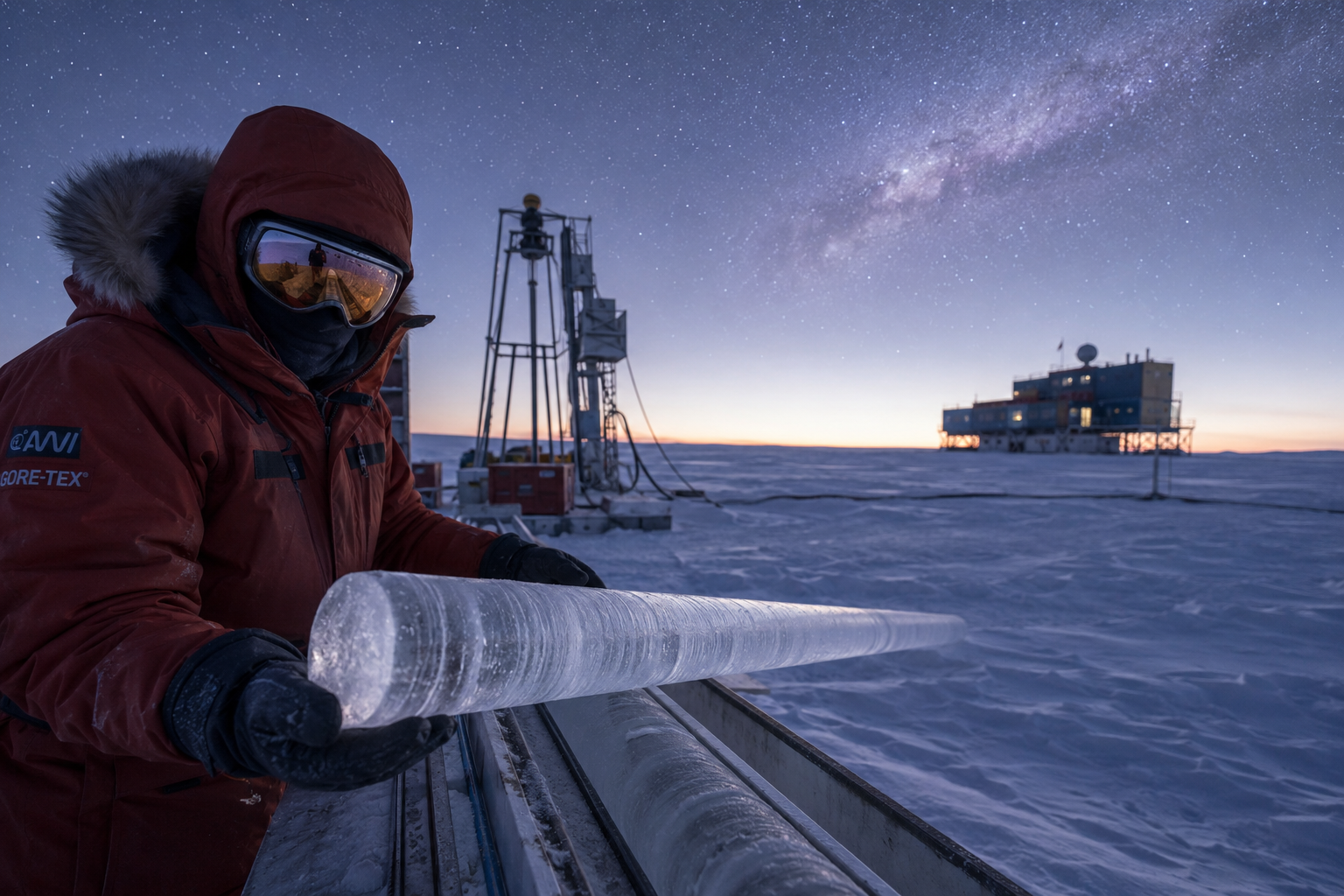
Researchers have discovered traces of the radioactive isotope iron-60 (60Fe) preserved inside Antarctic ice, providing new evidence that Earth’s surrounding interstellar environment contains remnants of ancient supernova explosions. The study analyzed ice core material dating between approximately 40,000 and 81,000 years ago and found measurable deposits of interstellar 60Fe embedded within the ice.
The research, published in Physical Review Letters, examined nearly 295 kilograms of ice from the European Project for Ice Coring in Antarctica (EPICA) Dronning Maud Land ice core. Scientists say the findings support the idea that the Local Interstellar Cloud (LIC) — the cloud of gas and dust currently surrounding the solar system — may act as a long-term archive of material produced by nearby supernovae.
What Is Iron-60?
Iron-60 is a radioactive isotope primarily produced during supernova explosions. Because it has a half-life of around 2.6 million years, it can survive long enough to travel through interstellar space and eventually reach Earth.
Previous studies had already detected 60Fe in deep-sea sediments, ocean crusts, lunar samples, and recent Antarctic snow. However, this new work extends the record further into the past and suggests that the amount of incoming interstellar material varied over time.
Evidence of a Changing Cosmic Environment
The solar system currently travels through the Local Interstellar Cloud, one of several nearby cloudlets within a region known as the Complex of Local Interstellar Clouds. Scientists believe these structures may have formed through interactions involving supernova shock waves.
The study found that the deposition rate of interstellar 60Fe between 40,000 and 81,000 years ago was significantly lower than the rates observed in more recent Antarctic snow and marine sediment records. Researchers calculated an interstellar deposition rate of approximately 0.22 atoms per square centimeter per year.
This changing pattern may indicate that the solar system moved through regions of differing interstellar density over time, or that it entered the Local Interstellar Cloud relatively recently in cosmic terms.
How the Ice Was Studied
The ice samples originated from the EPICA Dronning Maud Land ice core collected near Germany’s Kohnen Station in Antarctica. Scientists used accelerator mass spectrometry, an ultra-sensitive technique capable of detecting individual atoms of rare isotopes.
To ensure the integrity of the samples, the team also measured cosmogenic isotopes such as beryllium-10 and aluminum-26. These isotopes helped confirm that the ice preserved ancient radionuclides without significant contamination or loss during storage and processing.
Clues About the Origin of the Local Interstellar Cloud
The findings may help astronomers understand how the Local Interstellar Cloud formed. Several theories suggest the cloud originated through interactions involving supernova remnants, shock waves, or neighboring interstellar bubbles.
According to the researchers, the relatively low abundance of 60Fe detected in the older Antarctic ice may indicate that the Local Interstellar Cloud is not composed purely of fresh supernova material. Instead, it could contain older interstellar dust that was later mixed or seeded with newly synthesized elements from nearby stellar explosions.
A Geological Archive of Nearby Supernovae
The study suggests that Earth’s geological archives may preserve a long-term record of the solar system’s movement through different interstellar environments. By studying radionuclide signatures such as 60Fe, scientists may eventually reconstruct the solar system’s journey through nearby cosmic structures over hundreds of thousands of years.
Researchers also note that future high-resolution studies could potentially identify transitions between neighboring interstellar clouds or reveal how variations in the local interstellar medium affected the heliosphere and cosmic ray environment around Earth.
The discovery adds another layer to growing evidence that nearby supernova activity has left measurable traces on Earth, preserved across ice, oceans, and even lunar material over millions of years.